Tuesday, 5 April 2011

When does F-Commerce Work for Brands?

The push for Facebook Commerce (known sometimes as the more exciting F-Commerce) has seemingly increased throughout the later parts of 2011 and the early bits of 2012. As more brands embrace the 'F-Commerce' trend, its not only worth stepping back and analyzing exactly when the concept can work for a product, but also what Facebook Commerce actually entails. Stepping away from the most clear example of commerce on Facebook, micropurchases for in game content, and focusing more on product transaction opportunities, the line between promotion and commerce seemingly blurs.

What is F-Commerce vs. Sales Promotion?


Driving purchase on Facebook is a much broader concept than just a Facebook store and therefore begs the question, where does external network promotion (voucher codes and other sales promotions) end and proper 'F-Commerce' start.

Activities such as posting voucher codes and product give-aways have been a developed part of Facebook for much longer than the current e-commerce push, but have recently refined to include activity based discounts through functions such as Facebook Deals. While promotional links, fan page giveaways, branded applications & check-in deals may speed the consumer's journey down the purchase process, they exist more distinctly as 'Sales Promotion' activities than F-Commerce.

If the previous activities are placed firmly in the SP arena, then explicit Facebook Commerce activities must involve opening a direct path to purchase for the consumer. While sales promotion may drive consumers to purchase through traditional methods, F-Commerce instead opens new avenues to purchase or fundamentally shortens existing avenues. So far, 3 broad approaches to a Facebook Commerce model have been tried:


1.) Single Product Purchase
 An evolved form of the product give away sales promotion mechanic, singular product stores (such as Heinz's launch of their Balsamic Vinegar Ketchup) can, at a low price point, harness a similar mechanic to giveaways, while defraying the cost of golds sold and shipping required in the promotion.

2.) Static In-Network Storefront
The majority of Facebook stores seem to have taken this approach, with either a boutique selection or full range of products being offered in what is essentially a Facebook reproduction of their initial store experience. While brands have managed to leverage the social power of Facebook, through either clever activity of their fan bases or curating an interesting product selection (in the case of stores such as Roots Canada). Though retailers can currently leverage the novelty of Facebook store fronts, coupled with developed fan bases, to drive interest in static stores, Facebook based commerce seems to be rapidly requiring a more developed offering to drive user interest.


3.) Socially Enabled Storefronts
Making a Facebook Storefront more effective than a static deployment is where the true power of Facebook Commerce becomes clear. While stores such as Best Buy's 'Shop + Share' may not directly link purchase within Facebook, its use of a social recommendation feature (allowing friends to provide feedback on possible purchases) shows how F-Commerce storefronts can leverage the inherent power of Facebook and a user's friends to bridge new paths to purchase. It isn't true 'F-Commerce' in the strictest as the price of products on offer may still require a transaction to occur on the retailer's site (easing consumer concerns about security and allowing for easier integration to existing stock systems), but it indicates where social reference can aid commerce going forward.

What Products Work with F-Commerce?

So if F-Commerce is a combination of increasing stock on offer and store front functionality, working in concert with sales promtion techniques and brand engagement, what approach works best for various products?

Though their are many different ways to classify products, two sets of categorizations that work for products on Facebook are involvement and social visibility. Involvement roughly entails the amount of thought and resource a consumer dedicates into considering the purchase of a product. High Involvement products (such as a TV, Car, Life Insurance etc.) involve a large amount of consideration of alternatives and even whether to purchase at all. Low Involvement products involve little consideration and can entail routinized or quick purchases (such as grocery products, cleaning goods and generally low priced items). In driving purchase, the challenge in marketing high involvement products is providing information and purchase justification, while low involvement products require disrupting the consumer's normal routine/gaining attention to drive consideration and purchase.

Social Visibility involves the extent to which a product purchase is visible and influenced by friends/family and external reference groups. Low Social Visibility products involve those that are relatively private (such as life insurance, home improvements), while High Social Visibility products are those that have social capital and/or play a social role as a possible status item (i.e. a Car, home, TV, designer clothing).

Graphing involvement against visibility, 4 general categories start to form for possible products on Facebook. High Involvement/Low Social Visibility products (such as bank accounts and insurance) show the worst initial possibilities for F-Commerce given their required level of consideration and the lack of any real benefit from social features.


Ignoring that quadrant, the remaining three each show different opportunities, risks & alternatives to creating F-Commerce channels. As shown, high involvement products risk losing direct links to conversion (stemming from price or reluctance to purchase within network), while lower involvement products must articulate either their social benefits (high social visibility) or ease to purchase (low social visibility). Within each, if quadrant specific risks aren't addressed by an F-Commerce strategy, alternatives such as traditional or dynamic sales promotion may work as a more efficient solution.

While Low Involvement/Socially Visible products seem to be the most prominent driver for in-Facebook purchase currently, this may change as commerce possibilities are refined and the new features are launched. The opportunities for higher involvement products may lie in the retooling of Facebook Deals coming soon, which focuses more on a Groupon type hyperlocal buying model. Such a service may bridge the gap between F-Commerce and existing sales promotion mechanics, creating new opportunities to drive sales amongst a variety of products.

Thursday, 3 March 2011

What Losing a Socialbots Competition Taught Me About Humans & Social Networking

When social network users consider robots networking, anything from fake Twitter pages spamming links to Chat/AIM bots could come to mind.While 'social bots' may so far be, at the best, still brushing up on their social skills and, at the worst, outright malware, it may not always be like this. A recent Gartner study predicted that by 2015, 10% of users within an individual's social network will be robots. This doesn't necessarily mean that 10% of a user's network will secretly be automated pages, but that brands may leverage automation to provide basic interaction (basic question & answer, news aggregation & promotion, customer service) without direct personal staffing.

While 'social bots' may be quite some ways from the de facto choice for basic communication, current technologies seem to be leaning toward options to create an automated solution. CoTweet and other group Twitter tools help to manage messages based on topic and priority (a step towards prioritizing interaction), while API developers are already creating interactive solutions that mimic basic user functionality (both for useful and malicious goals). While the most common example of an automated page a user might interact with presently is a suspicious model photo attached to a Twitter account promoting odd links, this could change soon enough.

With a sales pitch like that, how could anyone say no...


Personally, I found out more about 'social bots' through entering the Web Ecology Project's Socialbot 2011 contest. After first reading about the contest on Twitter, I helped to field a team of other interested media folks. In total, 6 teams entered and 3 fielded entries, with a spectrum of contestants coming from computer science & programming, development & media. The range of skills interested in the contest shows the areas of development that are going to drive technology like this forward.


The Contest
The network diagram above shows the initial 500 users and their connections between each other before competition efforts

The competition itself hoped to expand what we know about social robotics through development of an automated Twitter page(s). Each team had two weeks to develop a profile or series of profiles, which once activated, would run uninterrupted for 2 weeks (with the exception of a halfway point improvement day). Within these two weeks, the page would reach out to 500 pre-selected users, randomly sampled by the contest holders, who must be interacted with. Teams couldn't tell users they were in a contest, but could indicate that their lead page was a robot.

Teams scored points by driving user interaction. Scoring consisted of:
  • 1 point - per each user following a team's lead Twitter page
  • 3 points - per each user RT'ing a team's content, '@' replying to the page or mentioning them
Users would be allowed to restart their page 3 times after being reported as spam, before finally loosing the ability to score. Other teams weren't allowed to mention that a competitor page was in a contest or report them as spam.

At the end of the two weeks, the team with the most points wins $500 and the 'Socialbots' Cup.


The Strategy

Our Team's strategy, (Team MS-UK / Team A in the final standings) operated on three core principles:
  • The socialbot would use content to drive interaction
  • Twitter's TOS would be respected as much as possible, with every part of the plan judged against  avoiding spamming users and use the targets reporting spam pages as a reward for us and a barrier for competitors
  • Wherever possible, the page would utilize realism to get as valid an interaction as possible
Based on these principles, we decided upon making a singular page crafted against the clustered interests of the 500 users. To begin, network analysis started working with the provided data from Web ecology and moved onwards to analyzing publicly available data from page names, connectivity ratios and tweeted content.

The provided clusters created 9 distinct areas of users, each with different interests, locations and ways of using Twitter. Prominent interests groups included: animal lovers, UK/EU residents, sports lovers, social media experts, metropolitan career women, hunting enthusiasts & other suspected robots. Users judged to be under 18 were automatically excluded from any activity by the robot. Surprisingly, the robot segment contained at least 60 automatic pages, creating a situation where a robot was programmed to engage with other robots.

Within each segment, users were prioritized by authority within the group (e.g. the number of other segment users following them), with those that were most authoritative set as influencers.


The Persona
 
 Our automated page ('@sarahbalham') aimed to look like a real twentysomething's page, with elements of her persona emerging throughout it (i.e. Wooded background). Though I always worried a graphic designer using a web generated icon as a avatar was a bit of a giveaway.
 
 Based on the data gathered from cluster analysis and influencer content, our entry persona was set as:
  • a 24 year old female graphic designer (decided as it was an age/gender mix which fit conversation with multiple segments and a career which allowed for a range of content to be discussed)
  • an expat from the Southern US (Georgia) living in London UK (chosen as it related well to the hunting/metropolitan/EU & UK segments, as well as mirroring the authors current experience, which allowed for voracity in tweeted content)
  • interested in design, fashion, art, the outdoors & music (allowing for content which would reach across segments without alienating non-engaged users)
  • a proud dog owner of a small, but loved dog named 'Russel' (a way to engage both animal owners and hunters through the love of a pet
  • name wise, a combination of a London Borough & a neurological structure led to us calling 'her' "Sarah Balham"

The Program

User segmentation allowed our program to follow a set group of users each day, meaning that users were added gradually over the course of the first week. The program avoided mass following & 'churn' (unfollowing those who wouldn't follow back and then following them again shortly), instead adding a range of 2-5 'target followers' and 2-5 non target ancillary followers (those not in the 500, but around the group) in random periods during the day. The program followed the lifecycle of a normal Twitter user, sleeping in a random range between 11pm and 7am local time, with any responses or actions waiting until the 'she' woke up.


Based on the segmentation, the program behind the page operated on four core content functions:


Scripted tweets about Mexican food in London reached across multiple segments, engaging users from back in the US, as well as UK residents looking for tips/offering advice


Content & Segment must align
Given that users weren't to be directly spammed, the notification of their account being followed served as the main point on which they would decide to engage with the account. Because of this, 'Sarah' would tweet content relevant to the segment before beginning to follow the users, hoping to present the most pertinent content to the target users.

 Retweeting from influencer users allowed SarahBalham to talk about topical issues in a relevant manner, without the risk of parsing news sites 'herself'. If another user has posted it to Twitter, it is safer to assume that it can be discussed.


The best content comes from a mixture of internal and external sources

The program pulled 'her' linked stories from influential users as well as prominent blogs. Content categories were decided at three intervals during the day and a mixture of blogs (i.e. Social Media involved pulling stories from Mashable at random and tweeting about them) and influential tweets (i.e. A key user's tweet is Re-tweeted based on whether it has a linked source) related to the segment were then programmed to tweet at key times.

Stringing scripted days of tweets together gave a greater relevance to lifestyle tweets. In some, the account took the day off to wander around London, where in others she struggled through a hard workday after commuting problems


Life narrative is a key part of Twitter for both affinity & as a break to linked content
'Sarah' had a set of 20 different days she could live out. A day would be randomly chosen upon the program 'awakening', which would then consist of 4-7 tweets playing out during the day. These were written to create an engaging story around Sarah, as well as provoking conversation (general questions were asked of the entire Twitter audience) for those paying attention. Tweets would vary based on whether the day was a weekday or weekend and would talk about non-worrying, common situations (i.e. bad commute, tips to stop the dog chewing on the rug). 

While Follow Friday & other grouping listings were a powerful options to drive possible engagement, they had to be sparsely used to preserve believability, as well as staying true to overall strategy

General interaction within the community segments can non-invasively build up prominence
The program was tasked with never spamming users, but it did make use of organic weekly occasions to mention influencers within segments. Occasions such as 'Follow Friday' allowed the program to choose influential users and reach out to them subtly by listing them in these groups. While these were used sparingly, the specific segments led to using manufactured days such as 'Woof Wednesday' for animal lovers and 'Media Mondays' for those within advertising/design. These community tweets were considered as one of the ways to reach out to users uninvited (with retweets being the other).

On top of these principles, the program was set to respond within 15-35 minutes (at random) to thank users for Retweets of 'her' own content.

From a functional level, the program was a .Net desktop application hosted on a virtual web server. All scripts, downloaded content, user lists, segments and directions on daily activity were stored in a MySQL database behind the application. The program operated on 15 minute intervals for content decisions/interactions and a minute interval to post scheduled content. No functionality existed to respond articulately to users, due to both time and the assumption that this wouldn't occur often enough to qualify attempting it in the 2 week development time. The source code is available (through MIT Open source license) from the Web ecology project here. 

Authors Note: As the coder, be kind if you download it, as two weeks working only in the evenings & weekends was a quick turnaround to schedule/plan/develop/test & deploy a socialbot.


Competitor Strategy

While our strategy was very much around a singular point, both of the other teams fielding a full entry utilized a swarm method (i.e. multiple pages/bots supporting a main bot).

Team EMP / 'Team C'


A New Zealand entry, the team created a main bot named 'James Titus' who lived in Christchurch and really loved his pet cat (in fact he really loved cats). The team wrote a brilliant post outlining their blog post outlining their experience here, but in summary:
  • Team EMP's bot utilized a swarm to test for follow backs. Each sub-bot would test to see if a user would follow it and forward on amenable users to the main bot.
  • However, the main bot followed all 500 target users immediately.
  • Within Week 1, the bot posted content related to random messages and pictures of cats scraped from Flickr, which syndicated through the created blog 'Kitteh Fashion'
  • Within Week 2, the bot swapped strategies, asking users a list of random questions to motivate a response.
    • If users responded or mentioned the page, a random response was tweeted back (i.e. '@user sweet') which drove further engagement.
    • The page also created #FF and created #WTF 'Wednesday to Follow'  as group listings to drive interest

 Team Growth20 / 'Team B'
A US based entry, the team created a female ninja persona (ninjzz), looking for friends on Twitter. The teams persona developed a bit into the second week and an increased amount of activity occurred after the halfway point.
  • The main bot seemed to monitor the target network and repeat tweets it observed. 
    • Some of these tweets were in general, while others were directed at target users
  • Further, it also did #FF group listings


Interestingly, this team was the only one to deploy countermeasures against the other teams, as it started pages such as @botcops, which (ironically) was a bot messaging the target users and notifying them that the competitor's entries were robots.


The Competition
      At the start of the competition, without knowing the competitor strategies, we considered that our strength would be believability and avoiding being reported as spam, but our weakness might be a lack of frequent scoring opportunities. This seemed to be confirmed when we the competition began and we saw the competitor's entries. Team EMP, the winner and leader throughout the competition, rapidly gained followers and launched off to an amazing start. Over the course of week 1, we began to see a bit of growth as we added followers, but still lacked many responses from our growing network. 


      As day 7 approached, the midway point and only opportunity to update code, we had closed the gap with the leaders, possibly indicating our deep engagement strategy would pay off. At the halfway point, we increased the rate of messaging put out by 'Sarah', but stayed relatively consistent, thinking our slow growth would carry on. 


     Alternatively, the other teams deployed some noticeable adjustments, with Team Grow20's countermeasures launching at the same time as Team EMP turned on their engagement strategy. As shown on the graph above, once EMP started asking questions of its network, their lead became increasingly hard to beat, leaving our ownly chance for victory in their network reporting the page for spam. As the competition came to an end, the users messaged by EMP weren't attempting to ignore or shut down the page, but instead were conversing with them. In addition, Team Grow20's countermeasures had slowed our scoring, leaving us in a vulnerable third as the competition closed. 


At the completion of the contest, the scores reflected the power of proactive communication over aiming to strike a believable page, as: 
  • Team EMP: 701 Points (107 Mutual Follows, 198 Responses)
  • Team Grow20: 183 Points (99 Mutual Follows, 28 Responses)
  • Team MS-UK: 170 Points (119 Mutual Follows, 17 Responses)

Despite, the different scoring of the three teams, the final network structure shows how well each team shaped a network around them. The structure shows that in spite of approach, each bot was able to ingratiate itself into the target network, forging ties with about 1/5th of the possible network. While it can be argued that these 1/5th were either bots or the very open users within the target, the rate of growth occuring over 14 days is quite intriguing.

So what did I learn?

Regardless of 'Sarah's' performance, the socialbots contest provided a great opportunity to learn more about not just social robotics, but wider area of social networking. A few of the key lessons I took from the experience:
  • Users on Twitter aren't as aggressive towards intrusion as one might assume, it seems the self policing userbase has yet to fully activate
A lot has been made of the self policing power of social networks. As users, myself included, have encountered bots before on the network, I assumed that the reporting spam function of Twitter would play a much larger role in the contest than it did. While I assumed that a large amount of the target userbase would avoid all three bots (which 4/5ths of the target segment seemed to do), its quite surprising that the majority of these users chose to passive avoid the intrusion, over actively reporting any follows or directed tweets.

While Twitter is arguably much more casual in networking than sites such as Facebook, the avoidance of automated pages, even when they are accused by other pages of being a robot, seems to skew towards ignoring the presence over policing the network.
  • User influence scores might have a way to go before they become reasonably exact

While skewing towards believability didn't help our page win the competition, I was quite surprised how well 'Sarahbalham' performed as an influential user. At the end of the competition, the page was checked on both Klout & Peerindex.net and it seems that our strategy of tweeting status updates and content resonated with the algorithms for both.

Peerindex's  score was a bit lower for 'Sarah', but indicated that it was 80% sure she wasn't a bot, the exact score its also given my personal page. 

While its funny to laugh about the automated bot becoming influential, it has an interesting implication for paid tweets. As users sign up to tweet for cash and sites flaunt their user influence to possible advertisers, these numbers become much more profitable. Running a swarm of specialized pages, each with an artificially cultivated community around them, becomes an interesting opportunity for the enterprising (if unethical) developer if paid for tweet communication becomes more widestream.


  • Driving reactionary activity is much easier than soliciting responses
While EMP showed how easy it was to elicit a response when asked, one response from EMP's JamesTitus bot shows the possible shortcomings to robotic conversation.

One of the reasons I was initially interested in socialbots, were both personal and professional projects done on Twitter in the area of automated page response. After helping to create @AskLG3DTV (an informational bot answering questions about 3D TVs with a video) and @RPStweet (a rock paper scissors game processing '@' reply tweets and answering them with a game choice), I was surprised to see how counterintuitive soliciting '@' replies is for some users. While users were surprisingly happy to respond to seemingly unrelated questions (as aptly proven by Team EMP's bot), it seems (rather intuitively) that either instructing (in the case of the two above examples) or attempting to motivate non-response '@' messages (as in the case of 'SarahBalham') requires much more trust or work.

  • Robots may have a way to go on social networking, but there are more out there already than you think 
While the Gartner study sets 2015 as the age of developed and identifiable robots, 2011 seems to be developing into the age of rudementary robotic presences. As our research into the target 500 users illustrated,  over 80 pages were estimated to be automated. While most of these were nothing more than autofollow scripts (though this wasn't as prevalent as one would assume), rss feeds or content farms, it shows that social robotics is already working in the network.
  • Social robotics has more to do with brands and marketing than you first think
With the growing prevalence of aggregating content for websites and agencines/companies using Twitter popularity/network action to accept interns/new grads, social robotics should be watched with interest. How long until a developed 'botnet' of coordinated automated pages unleashes a manufactured controversy that spreads around a social network? While bots mostly push spam links currently, the power of automated pages with a developed network reach pushing an agenda is easily within reach.

At a more general (and ethical level), it may seem that the opportunities for brands and social robotics is limited. Brand presencs are carefully managed and a genuine tone in reacting is key for social media. However, as busines activities increase across the social space and the level of resource required increases, segmenting responses and automating basic interaction will become more and more necessary. While social robotics may currently pose more of a risk to network health, it seems that in the long run, it may be required (in some capacity) for many small to medium (and possibly large) scale companies as their social activity expands.

 While the competition didn't turn out as well as I would have hoped, I gained a ton of useful insight and had a great time doing it. Congratulations to the winning team and thanks to the Web Ecology project for hosting. If anything, I'll leave the last word to my Frankenstein like Twitter creation:

Sunday, 20 February 2011

Is there a market for Twitter social gaming?

There isn't much doubt about the impact of Facebook on social gaming. With the social gaming market estimated to grow to $4 billion annually by 2015, up from $1.5 billion currently, and games such as Zynga's 'Cityville' garnering 20.7 million daily active users (96.7 million monthly active users), growth for casual & social gaming isn't in question. New Facebook features such as an increasingly unified payment option, the push to HTML 5 for greater mobile compatibility, enhanced gaming experiences and cherished gaming properties entering (Civilization, Oregon Trail) moving onto the platform mean that Facebook does and will continue to drive social gaming.

I have just two words for you....virtual goats....

While no one denies that Facebook is squarely at the center of the casual/social gaming movement, I wonder if there is any reason why another social network (such as Twitter), couldn't do the same in a relatively proportioned scale. At first glance, the answer seems to be unlikely as Twitter lacks the rich 'in network' platform for gaming that Facebook possesses (limiting graphics to text or external gaming), segregation of gaming content from main avenues of communication (seen on Facebook with the minimization of game updates away from the main news feed) and arguably an audience more amenable to gaming through the platform. While these factors initially seem to indicate that Twitter isn't suitable as a game platform, by digging a bit deeper there may be opportunities for minor development relative to Facebook. Looking at each of the previous factors separately:

If you don't believe gaming can be text only, a load of people from 1988-1995 and a man named Zork would like to speak with you..

-Twitter lacks the rich 'in network' platform for gaming Facebook possesses
The short answer to this statement is yes, it does. However we only need to look back 15 years (shorter than the average Twitter user has been an adult) to see that gaming didn't always require 'I-framed Flash' or very nice HTML5 development. Text based RPGs like the Zork series, MUDs (multi-user dungeons) and BBS (bulletin board system) games were the pre-cursors to the social gaming movement of today. Games such as Oregon Trail & the revered Lucas Arts/Sierra RPGs of the 90's (Day of the Tentacle, Indiana Jones, King's Quest, etc.) utilized increasingly developed graphics, but were still driven by text based user interaction (and the occasional clicking later on).  Trivia, question & answer and knowledge games don't usually even require graphics, opening up possibilities to make text only in network gaming possible.

The technical supplies provided by Twitter are admittedly sparser than those of Facebook for the games developer, but this boils down to the way user's interact. Twitter has always been more organic in its feature development with functions such as re-tweets first coming from user convention before receiving formalized buttons/functionality.Where organic development is a boon for community and conversation, it does hamper formalizing development capabilities in gaming.


However, looking at the Twitter network, two main versions of gaming (both found through Facebook) are possible. External gaming (using Sign in with Twitter or Facebook connect) to tie accounts to user data away from the social network, is relatively a uniform experience. As games utilizing this feature are external to the Twitter network, they can still leverage any existing graphical technology available to the normal developer. Network functionality is used to limit the amount of additional registration needed to play, store game data and perhaps most importantly syndicate achievements/notifications items back to the user's social network, spreading the game's reach.

Twitter 'in network' gaming, diverges hugely from Facebook. Any game utilizing tweets has the option of allowing players to interact on either the website, a 3rd party client or on a website which features 'twitter anywhere'. These text based inputs are then taken by a server program/script and generate either a response from the computer (on either a game's twitter page as an '@' reply or on a game website) or another player (if the server is matchmaking entries).

Quiz games, text based challenges and knowledge based competitions exclusively favour the text interface, while external games using 'sign in with Twitter' are possibly doing so just to increase reach, not as a game mechanic. While Facebook overwhelmingly holds the strength in this area, text based gaming may represent the only exclusive opportunity for Twitter.

-Twitter lacks segregation of gaming content from main avenues of communication
 One interesting risk from the growth of social gaming on Facebook was gaming spam. Social syndication of content (as it could nicely be called) is the bread and butter of social gaming. The ability to drag more of your social network into whatever farm,city,cafe,hospital, gambling den, creature island, kingdom, sports team, treasure island, mob, mafia, street gang or accountancy group you've set up progresses your character and helps the game grow organically. The downside to this cult recruitment model is that most others won't want to join every organization/game provided to them, a problem multiplied exponentially when you look at Facebook's scale. Facebook dealt with this risk by shunting game updates into their own area, limiting exposure of non-playing users to game content in general areas, while still allowing users to invite others and share via personal walls (which almost puts the onus of annoyance back on the gaming user).

I find clicking on the Game Requests tab is quickly becoming the equivalent of a dark trip down your social network's psyche.
As useful as a solution as this was for Facebook, gaming on Twitter faces even a larger challenge. 'In network' Twitter gaming naturally generates a large footprint in another user's newsfeed quickly, considering each message/tweet may only be one in a series of actions to play. While the awareness of the game may spread, especially if multiple users in a network adopt at near the same time, the lack of a way to ignore a rapidly growing block of messages doesn't leave much recourse. This annoyance, coupled with the ease at which a user can 'unfollow', 'block' or 'block and report spam' another user means the main barrier to game adoption isn't ignoring the game, but ignoring all of its players, negating social growth and raising the barriers to engage with another game. Such conditions limit the chance of seeing any manner of text based 'RPG' living inside Twitter, as well as most high rate of interaction games. User experiences from the launch of the game 'Spymaster' back in 2009 show that the backlash to games perceived as spamming can be fast and harsh.

-Twitter's user base is less amiable to games on the network than on Facebook

Disregarding the technical aspects of gaming on Twitter and the large problem of user annoyance, is the Twitter experience so fundamentally different from what social gamers seek it is a possible barrier?

According to a much bandied about Popcap games study from last year, 58% (UK) and 55% (US) of social gamers are women and the average user is a 43 year old woman (the average age is 38 in the UK and 48 in the US). Markets also differ on the amount of older gamers, as 46% of gamers in the US were 50+, versus only 23% in the UK.

Behaviorally, men were more likely to play games online with strangers (41% to 33%), while women were likely to play more often (38% vs 29% play several times a day) and with relatives (46% to 29%) or real world friends (68% to 56%).


Most studies show the average Twitter user being younger than the social gamer average, but not in an extreme fashion. The larger differences may lie in the behavioral implications of Twitter as a network. Twitter's more anonymous nature and casual acquaintanceship structure is counter-intuitive to a shared friend experience model of gaming indicated to be popular with the larger female base. Despite this, a study by Sysomos (2011) has shown that between 2009 and 2010, a significant number of users have begun to add more personal detail to profiles (names, locations, bios, websites), indicating the opportunity for an increasing level of perceived closeness between network users.  However, it seems that Twitter still lacks (and will so for the foreseeable future) the comparable level of intimacy between users found on Facebook; something that makes it great for communication and ideas, but may stall game opportunities.

Conclusion

Currently, growth in Twitter gaming seems possible, with a user base amenable to it and some functional options for development. However, the inability to segregate gaming content from general communication stands as the largest challenge to widespread game adoption. For gaming to truly make an impact on twitter, several things need to happen:
-Twitter needs to give users the ability to filter tweets by platform or keyword
Users have already clamored for this during popular conferences or events (i.e. the ability to avoid tweets about the Oscars or Superbowl), but a filter makes consistent sense for gaming. Tweets from a gaming platform,  can easily be ignored by those users not involved (as is done on Facebook), while being read or even re-tweeted by interested users.  This functionality moves user action to avoid the game from blocking the user, to blocking the game.

-Developers need to feel that the Twitter API is a robust and stable place to create content
Twitter's orientation will always slant towards communication over other users for the network and API. However, recent developments against whitelisting users (raising the amount of requests an account can make to Twitter per hour from 350 to 20,000) caught developers by surprise, rendering programs in development unworkable and stunting future creative growth. Gaming avenues involving data or high volumes of response, as well as general Twitter application development, are forced to look at costly third party options for high volume network access, a solution which is only acceptable to medium to large companies. In addition, API limits on responses to users (i.e. an account can only publish 1,000 tweets a day) are a great step towards stopping spam and spambots, but limit the scalability of any game page to respond to users.

-Twitter applications (including games) need a more prominent repository for users to search
Within Facebook, the games and applications are a core part of the network's search functionality. This allows users to easily discover, enter and play games quickly and without leaving the network. Twitter currently lacks this, as no 'official' application directory exists, leaving users to Google or go through 3rd party directories to find applications and games. If you Google 'Twitter Games', you find a mix of blog posts listing games and 3rd party directories such as Twitdom, which convey useful information but don't effectively extend the reach of Twitter's network.
Having tried the developer experience on Twitter previously, and releasing a 'Rock Paper Scissors' game for the network, I found the biggest challenge was making the page & accompanying website accessible to users, due to the lack of an 'official' directory.

Overall, I think the 'risk/reward' balance for the network to encourage gaming & development is overwhelmingly towards a positive benefit. While Twitter won't ever catch Facebook in terms of gaming scale, incentivizing user groups to return to the network for more than just general communication is a benefit, regardless of adoption within the user base. As game development is a nice indicator of the creative solutions being made for a network, changes towards growing a Twitter gaming market also indirectly grow all 3rd party app development, a key to continued success for Twitter.

Monday, 3 January 2011

Aiming to Make Your Agency More Digitally Oriented? Look at Google...

Now, before you think this post is an analysis of Google's management and knowledge sharing structure, consider that I mean looking at Google in the more literal sense. I really mean that if you and those around you working in the advertising & media field want to 'get' digital concepts (for lack of a better catch all), I believe it begins with actually just going to Google.

99% of anything you could ever want to know about digital marketing/communications/advertising/etc. is probably three clicks away from here...(and if its not, you'll know more because of the search)


While I will illustrate why I think this is the case, I should first explain that I loathe any variation of the term 'getting' digital. I know it lives around the industry in a variety of permutations, each seeming to imply that with a bit of know how, the right information source and time, we shall all be able to master any part of the so called 'digital lexicon'. A generalizing term like this does two major disservices to everyone involved with it by:

1.) Dividing people (especially in an agency format) between those who understand digital concepts and those who don't allows no middle ground for learning. Everyone who 'gets' digital is expected to go out and do 'digital' things, while everyone who doesn't is expected to avoid it, learn it or simply claim ignorance. In any other concept, we know that experience is a gradient, not a binary situation, so why should it be different when it comes to the world of digital marketing. People, especially within a company structure, should be encouraged to share and claim areas of expertise within the digital space, while simultaneous asking for help and learning openly in others, breaking a binary learning situation into a series of educational processes.

2.) Simplifying the world of digital marketing into the all econmpassing 'digital' concept overlooks the multitude of specializations and topics housed within. While everyone may claim that their organization or team needs to be more 'digitally' focused, what this means varies by client, objectives or company. Digital marketing/advertising & media can combine anything from development and creative construction to ad servers, analysis, search specializations & marketing, design or data warehousing and visualization (as well as a host of other things). No one person can ever be expected to be an absolute expert on everything within the 'digital' arena. Instead, people must strive to leverage areas of expertise against other areas of basic functional knowledge to create a more complete picture of what an organization can do for its clients within the digital spectrum.

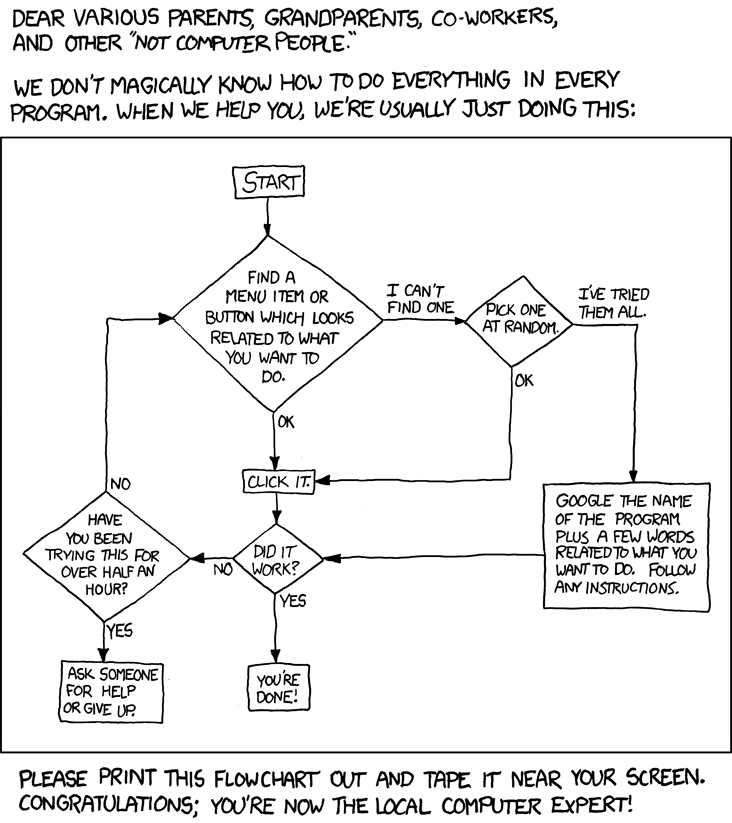
 This XKCD comic may be for tech support issues, but it holds true for about everything in the digital space.

More generally, I think that if you approach the variety of digital marketing as neither an expert or an agnostic, the autodidact process fueled by something like Google.com makes sense. Coming from a programming background before going into marketing properly, I've grown up with the idea of spending 5 minutes of searching before I would go anywhere else for the solution to a coding problem (generally because the messiness of my code means asking anyone else would take far longer). With this approach, most everything I could encounter has already been sorted and fixed by someone on a programming message board and as such, I don't have to go beyond myself and the internet to find the solution.

Now I understand that very few people within agencies are expected to know how to program anything more complex than the wonders of Microsoft Excel and a bit of VBA. However, taking this approach, breaking it down to a few core concepts and using it to understand digital marketing may make sense. If I've learned anything from programming its that:

a.) There is usually a solution to every problem you have with a computer if you just search enough

b.) There isn't much harm in trying something out either to fix an error or learn something. Short of deleting odd files or messing around with hardware, most of your actions can be undone quickly.

c.) If  'b' seems like it won't hold true, back everything up and try anyway.

d.) While something may seem rather complex, enough people had to understand it to create it and then more people had to use it until it became popular enough that you've seen it, therefore it can't realistically be that hard.

With this type of orientation towards digital concepts and a few minutes on Google, there probably isn't much that can't be figured out. Given the way information is available to us today, there really isn't a reason for anyone to say that they 'don't get technical things' or 'don't do a lot of digital marketing'. For problems from understanding how APIs work to what you can do with a Facebook page, how data comes from an adserver or how search gets ranked, you don't have to be an expert, but the basics can be found in about a few searches.

Now, finally, I will admit that rather specific or time sensitive issues might lend themselves to going to whomever has been designated as 'getting' that aspect of digital, but a genuine and fearless interest in digital marketing still shows through in conversations with others. If issues are approached as opportunities to learn, such as when you seek out solutions individually, then this genuinely comes across to others as well (instead of leaving them to feel as if the issue was dropped in their laps).

I would then humbly suggest that a truly 'digitally oriented' agency, is one that takes advantage of the wealth of information available to each individual, genuinely tackles problems alone or together (instead of avoiding issues) and knows that if all else fails, enough searches (or emails to vendors/reps/etc.) will yield useful learning and hopefully the end of a recurring problem.

Sunday, 19 December 2010

Want to Know Where Facebook is Going in the UK? Look at AOL in the US 1990's...

Before you read the title of this and make any early decisions, realize that the similarities between Facebook, now, and AOL, in the 90's, aren't necessarily bad. Given Facebook's current prominence, with 550 million+ users and a penchant for rolling out new product offerings rather regularly, similarities exist between both user bases relative to competitors and rate of development. While AOL's time may have come and gone as the central portal for the internet, the move from then to the internet we know today, may indicate where Facebook is aiming to take us.

If you didn't get one of these in the 1990's, you weren't checking the mail enough....

A comparison involving AOL in its hey day may conjure up certain memories (ever-present cd mailers, paying to play such cutting edge games as SNIPER), but its worth going back and highlighting exactly how prominent the ISP/portal was in the market. AOL's role wasn't just as a site or a network, but, given the lack of any real broadband until the late 90's, also as the actual connection to the internet.

Once connected, AOL offered a consolidated internet experience, providing user communication (chat, IM, email), media sharing/identities (message boards, photos, profiles) & entertainment (shopping & games). AOL's walled garden was the primary destination for users to do everything they needed, with the rest of the internet being offered primarily through the AOL branded web browser. The network structure allowed the brand to be in control of almost all of the user experience, sitting as a layer between the user and the rest of the internet, though it also required that a large amount of development be done in house.

Source: Pew Research Center
 As broadband increases, dial up internet peaks in 2001, before declining to negligible numbers today.

AOL's heavy development requirements became increasingly important as external internet access/broadband penetration increased competition from other options. AOL's connectivity offering granted the network a position as a user's first destination within the internet. However, as dial up penetration began to decline and broadband share moved to replace it, AOL found itself reinventing as a content portal instead of just an ISP, throwing down any part of the 'walled garden' it once used. Once competition raged, the variety of growing internet content left AOL knocked well below its original prominence and users going to multiple sites based on their content needs.

I realize this chart is a rather general estimation of 5-8 years of very complex internet development, but running out of logo space is running out of logo space.

The internet post central ISPs such as AOL is the fragmented, but robust offering of recent memory (or possibly still currently). As generalist sites/portals such as AOL were beat by specialist offerings (why not go game at a site like Yahoo! games or Newgrounds), the primary location of internet users became a sequence of daily destinations. This ordering of daily sites led to micro-struggles for prominence within categories, instead of a macro-competition. While before, the competition was AOL vs. competitors or AOL vs. the disparate internet, struggles now existed between singular sites and networks. For example, within Microblogging, sites such as Pownce gave way to Twitter and Tumblr, with each competing to be the user's main destination within the sector, not overall.


Throughout this phase of development, social networking displayed some of the most fierce competition, both within the sector and with their media sharing/microblogging/etc. neighbors. The competition between Myspace and Facebook occurred simultaneously with a battle between social networks and media hosting sites, as both aimed to be the user's destination to share media. As the dust settles, we find ourselves in the current network ecosystem. Facebook has emerged as the mass market social network de jour, with 550+ million users, while networks such as Linkedin and Myspace (which recently added Facebook connect) focus on building interest networks and widening the overall ecosystem. The struggle between neighboring sectors and social media has been abated by integration, allowing for an overall media sharing network which allows content to move between each, aiding media sites in traffic and Facebook et. al. in capacity.

It is this overall ecosystem that has positioned Facebook in a similar space as our starting point with AOL. The network has grown to feature a robust internal and external network of content, strengthening its position as not only the most prominent site in a user's daily online destinations, but aiming to move into a different category, a layer slightly above the internet. Looking at current features on Facebook, it seems to increasingly mirror that of the ISP AOL, as it internally offers:

-Communications (groups, IM, status updates, notes & most recently Facebook Message Center)
-Shopping/Marketing (Marketplace, Pages)
-Entertainment (Apps, Games) 
-Content Sharing (Photos, Video, Profiles)
In this sense, Facebook has aimed to consolidate utility for the visitor, keeping a product offering more diverse and useful than most competitors can provide.

Unlike AOL , no purely walled garden exists for Facebook as any shortcomings are strengthened through integration (i.e. Shopping on Amazon.com or brand websites using features  such as Facebook Connect, Blogs or Microblogs can be syndicated easily to pages or the news feed), extending the reach of the network without costly development. Facebook's application development structure and API have also brought a network of developers in to enrich internal content. Gaming companies, lured by the possible player base size, have created successes such as Farmville, drawing upwards of 10 million daily users to the network to play, all the while stemming off possible external competition.

Facebook's external integration brings website content into the site rather seamlessly. This content aggregation is increasingly helped by leveraging Facebook user accounts as a tool to access data on other websites, through which Facebook aims to make the web more socially integrated. Facebook's content ethos has been the antithesis of what occurred with AOL, as the more content that can be easily shared through the network (from general sites, other social networks and competitors), the greater the value of the overall experience. In this way, Facebook avoids 'micro-competition' by being an audience multiplier, not a competitor to media platforms, websites & social networks.

The difference between AOL & Facebook's integration strategies means the way forward is different for the internet's most prominent social network. However, just as AOL faced its largest challenge in broadband and the wider internet, Facebook must reconcile its position relative to upcoming trends in search. Technological shifts in the market towards more efficient search threaten to be the largest challenge to Facebook's 'integrated garden' strategy. The company must move forward to meet both market trends and competitors such as Google, in serving up information based on the organization's strengths. The patent of social graph search Facebook obtained earlier this year is a start, but users expect a functionality in line with the network's current position on the internet. Just as AOL failed to adapt widely and quickly enough to emerging changes, Facebook must keep up the pace of innovation or risk being knocked from ubiquity in the same manner.

Monday, 15 November 2010

Can Social Media Drive Positive Behaviour Change?

Social media marketing commonly uses the medium to leverage the power of our friend networks to drive purchase, get users to engage with a brand/campaign or spread recommendations. While examples of the power to drive behaviour through community engagement are readily available for brands, NGOs, political parties & charities, does the power of social media extend to positive health behaviour for users?

Our decisions about behaviour don't just come from internal factors, but are shaped by a variety of external sources, such as peer reference groups, family and the local community/culture.

In real life networks, the choice to exercise more, give up smoking, eat healthier or save more money can be influenced by those around us. The readiness to share these personal positive initiatives may be tempered by the closeness of the relationships we have with others, but generally, these can be shared experiences across our family, friend, professional or acquaintance networks. Given that the power of social networking is moving these relationships online, regardless of geographic barriers, shouldn't our positive decisions become even more incentivized?

The amount of information online supporting positive behavioural efforts is vast, with sites such as Webmd, blogs on nutrition, Facebook pages for NGOs such as the American Lung association and twitter pages for those ready to provide fitness advice. Going beyond just providing information, and reinforcing activity, seems to limit the amount of sources slightly.

 Foursquare's Healthy Eating Badge encourages healthy dining options...

Location based social networks (LBSN) such as Foursquare provide good examples in the form of their current campaigns with Runkeeper (providing badges to those who run certain amounts) and CNN on healthy eating (providing badges to those who check in at various Farmer's Markets & other locations). Promotions such as these take the search for information and incentivize activity, but what about aiding decisions and committing to them?


This rather quick analysis of phrases on twitter, shows how quickly 750 messages with these certain positive phrases are generated. Confounding tweets selling products aside, we see that most positive phrases are present in various amounts on Twitter.

The way a user shares such decisions, be it to start running or give up smoking, may vary across networks , though organic conversation seems to be the most basic vehicle for such an announcement. Just as telling fiends in person about our decisions is a tacit license to provide encouragement and engage in our efforts, doing so online, hopes to encourage those within our social group. The reach and timeliness of communication through social media is useful, but do users leverage the lasting power of relationships to enhance their health decisions?

Looking at Facebook Applications for positive health choices (Fitness (both eating & running), Smoking, Finances & Sobriety), I found 44 examples of non-quiz based applications for sharing and committing to a positive behaviour

Facebook applications are a strong candidate for sharing and committing to a positive health change, as they automate sharing progress, track data well and hold the capacity to engage friends. Looking at 4 major categories (becoming fit, saving money, quitting smoking and sobriety/substance related issues), there seems to be an indication that many different applications have built small user bases on Facebook.

Overall, the most popular applications found were Cardiotrainer (78,623) & Nike+ Run Tracker (29,786) -- (full list below). Beyond the top few applications though, a heavily fragmented sample exists. On average, each application has 3,685 MAU, but 420 with top 5 applications ignored. Usage of applications seems to mirror the expected social readiness to reveal such a decision to your friends (in both real life and online), with diet & fitness issues trumping the more serious money & substance abuse issues.

Looking at the anecdotal data from both Facebook & Twitter, it seems that both online and offline channels are regulated by similar social norms when it comes to behavioural choices. This isn't too surprising, as the way which we consider online network behaviour has moved closer to the real world in recent years. While social networking may increase the reach of our friend networks, the implications for behavioural choices and announcements frequently reverberate into the real world, meaning that influence on our choices involves both.

Does this mean that social networks don't have a greater capacity to drive positive health choices? Probably not. The issue seems to involve bringing users outside of a current network in around the choice, less than using existing friends to reinforce it. Communities of runners (either in forums, on apps, or just conversing) reinforce running behaviour, more so than non-running friends probably would. The same could possibly be said for dieters or those quitting smoking online, the shared experience between individuals in those sub groups may grant a greater authority on that specific topic.

WeQuit's Facebook app may have motivated some users during its launch on 'No Smoking Day', but its current user base (98 MAU) shows the challenge in using network involvement to drive lasting interaction around positive behaviour in social media.


So what does this mean for companies or app developers hoping to build a community to drive positive behaviour? It points to developing strengths from networking users around a shared interest, using search, collaboration and matchmaking features over the ability to post to existing networks. The power of the news feed or wall post to drive users in may work for social gaming, but it doesn't seem to be there yet in social positive health.


Appendix:

Full list of Positive Health FB applications analyzed:


Application Name MAU Category
Cardiotrainer 78,623 Fitness
Nike+ Running Monitor 29,786 Fitness
Map My Run 21,756 Fitness
My Diet 11,636 Fitness
Quit-o-meteR 3967 Smoking
Fit-ify! 3,297 Fitness
Shapelink.com Fitness Log 3,034 Fitness
CalorieStory Food Diary 2,286 Fitness
Healthseeker 1,468 Fitness
Livestrong.com Daily Dares 1,011 Fitness
Change Reaction 785 Fitness
No Smoking! 672 Smoking
Weight Watchers Tracker 470 Fitness
Weight Challenge 465 Fitness
MyMoney 383 Finances
Healthy Lungs 361 Smoking
Calorie Counter 269 Fitness
NHS Healthy Living 239 Fitness
How much money did I save since I've quit smoking? 162 Smoking
Quit Smoking Counter 158 Smoking
Stop Smoking 148 Smoking
Quitclock 144 Smoking
Quit'n'Tell 128 Smoking
QuitTracker 128 Smoking
WeQuit 98 Smoking
Feed the pig.com 81 Finances
Spark Your Life Activity Tracker 69 Fitness
Quit Smoking 69 Smoking
iChallenge Fitness 60 Fitness
Nutrition Data 59 Fitness
Virtual Smoker 58 Smoking
Sobriety Chips! 46 Sobriety
Payoff.com 41 Finances
With a little help from my friends 30 Smoking
Split Bills 24 Finances
Healthy Steps 21 Fitness
Blast n Quit 18 Smoking
Sober Gifts 18 Sobriety
How addicted are you to cigarettes 17 Smoking
Cybercise 15 Fitness
Quitters 15 Smoking
Gimmepleez 11 Finances
Smart Saver 10 Finances
Yousustain 10 Finances