Showing posts with label Digital Advertising. Show all posts

Monday, 3 January 2011

Aiming to Make Your Agency More Digitally Oriented? Look at Google...

Now, before you think this post is an analysis of Google's management and knowledge sharing structure, consider that I mean looking at Google in the more literal sense. I really mean that if you and those around you working in the advertising & media field want to 'get' digital concepts (for lack of a better catch all), I believe it begins with actually just going to Google.

99% of anything you could ever want to know about digital marketing/communications/advertising/etc. is probably three clicks away from here...(and if its not, you'll know more because of the search)


While I will illustrate why I think this is the case, I should first explain that I loathe any variation of the term 'getting' digital. I know it lives around the industry in a variety of permutations, each seeming to imply that with a bit of know how, the right information source and time, we shall all be able to master any part of the so called 'digital lexicon'. A generalizing term like this does two major disservices to everyone involved with it by:

1.) Dividing people (especially in an agency format) between those who understand digital concepts and those who don't allows no middle ground for learning. Everyone who 'gets' digital is expected to go out and do 'digital' things, while everyone who doesn't is expected to avoid it, learn it or simply claim ignorance. In any other concept, we know that experience is a gradient, not a binary situation, so why should it be different when it comes to the world of digital marketing. People, especially within a company structure, should be encouraged to share and claim areas of expertise within the digital space, while simultaneous asking for help and learning openly in others, breaking a binary learning situation into a series of educational processes.

2.) Simplifying the world of digital marketing into the all econmpassing 'digital' concept overlooks the multitude of specializations and topics housed within. While everyone may claim that their organization or team needs to be more 'digitally' focused, what this means varies by client, objectives or company. Digital marketing/advertising & media can combine anything from development and creative construction to ad servers, analysis, search specializations & marketing, design or data warehousing and visualization (as well as a host of other things). No one person can ever be expected to be an absolute expert on everything within the 'digital' arena. Instead, people must strive to leverage areas of expertise against other areas of basic functional knowledge to create a more complete picture of what an organization can do for its clients within the digital spectrum.
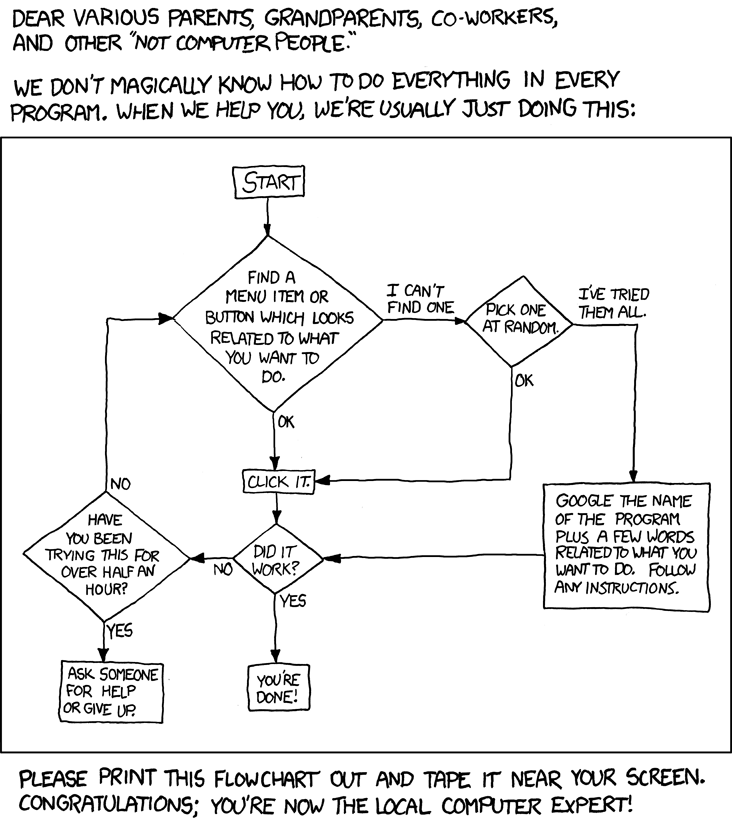
 This XKCD comic may be for tech support issues, but it holds true for about everything in the digital space.

More generally, I think that if you approach the variety of digital marketing as neither an expert or an agnostic, the autodidact process fueled by something like Google.com makes sense. Coming from a programming background before going into marketing properly, I've grown up with the idea of spending 5 minutes of searching before I would go anywhere else for the solution to a coding problem (generally because the messiness of my code means asking anyone else would take far longer). With this approach, most everything I could encounter has already been sorted and fixed by someone on a programming message board and as such, I don't have to go beyond myself and the internet to find the solution.

Now I understand that very few people within agencies are expected to know how to program anything more complex than the wonders of Microsoft Excel and a bit of VBA. However, taking this approach, breaking it down to a few core concepts and using it to understand digital marketing may make sense. If I've learned anything from programming its that:

a.) There is usually a solution to every problem you have with a computer if you just search enough

b.) There isn't much harm in trying something out either to fix an error or learn something. Short of deleting odd files or messing around with hardware, most of your actions can be undone quickly.

c.) If  'b' seems like it won't hold true, back everything up and try anyway.

d.) While something may seem rather complex, enough people had to understand it to create it and then more people had to use it until it became popular enough that you've seen it, therefore it can't realistically be that hard.

With this type of orientation towards digital concepts and a few minutes on Google, there probably isn't much that can't be figured out. Given the way information is available to us today, there really isn't a reason for anyone to say that they 'don't get technical things' or 'don't do a lot of digital marketing'. For problems from understanding how APIs work to what you can do with a Facebook page, how data comes from an adserver or how search gets ranked, you don't have to be an expert, but the basics can be found in about a few searches.

Now, finally, I will admit that rather specific or time sensitive issues might lend themselves to going to whomever has been designated as 'getting' that aspect of digital, but a genuine and fearless interest in digital marketing still shows through in conversations with others. If issues are approached as opportunities to learn, such as when you seek out solutions individually, then this genuinely comes across to others as well (instead of leaving them to feel as if the issue was dropped in their laps).

I would then humbly suggest that a truly 'digitally oriented' agency, is one that takes advantage of the wealth of information available to each individual, genuinely tackles problems alone or together (instead of avoiding issues) and knows that if all else fails, enough searches (or emails to vendors/reps/etc.) will yield useful learning and hopefully the end of a recurring problem.

Friday, 16 July 2010

What can the Means-End Chain teach us about digital content?

      So, its no big secret that two of my largest geek obsessions: psychology & digital marketing, come together rather often on the blog. However, where as I normally start with a digital marketing concept/story and throw in some consumer psychology, I thought it might be entertaining to do the opposite.


Aside from being as far from the actual World Cup as possible, what makes Nike's ad easy to share while others aren't?

      With this in mind, I was recently considering what tools might be useful to differentiate the mass of digital content posted by brands. With the World Cup coming to a close and people marveling over the number of views advertisements like the Nike 'Write Your Future' video garnered, its interesting to consider what separates this from other similar, less viewed World Cup content. Along these lines, I thought I would take a relatively basic consumer psychology concept, the means-end chain, and apply it rather liberally to the world of online viral marketing, to view content in new ways.

What is the Means-End Chain?

       The means-end chain is, at its most basic, a way to describe how a product interacts with the consumer. Whereas more complex explanations can be found elsewhere, for our purposes, I'll go with a basic definition I've used since school At its heart, a product on the means-end chain breaks down in three different areas:
Not every product touches the consumer in each of these areas (some basic products may only deliver a basic benefit and possess simple attributes), but by analyzing a product along these lines, we begin to take apart its essence. Within each of the three groupings, two subgroups exist, which begin to paint a progression for product analysis (shown below).
 These six sections allow marketers to analyze not only how a product interacts with the consumer, but where advantages may exist in relation to similar products. For example, on the surface, few differences exist between Coke & Diet Coke. If we put Coca-Cola Classic on the means-end chain, we see that it hits the boxes expected from a soft drink:
Purchasing, possessing & consuming a Coca-cola isn't a life changing decision, no matter how many people you buy a Coke for or teach to sing. Even its psycho-social benefits (those conferred from others) are tenuously weak, with a fleeting acceptance coming from only the most needy of consumer. However, when we compare it to Diet Coke, we can see that in some interpretations, a soft drink can become more than just a beverage.
By dipping into enabling values the consumer may have about fitness or getting into shape, Diet Coke has the ability to interact on a level traditional Coca-Cola cannot. While it may be tenuous to say that one Diet Coke could enable a consumer to achieve a step towards a long term goal, it does point out how we project possibilities onto products in noticeable ways.

What does this have to do with viral content?

Moving away from the straight forward example of two related products, its clear to see that the basic concept of the chain is useful to think of products in a different way. However, relating this product analysis to online content however, may be more difficult.

When someone mentions viral marketing & the internet, a variety of things can come up. From tweets to pictures, video & websites, users & brands both enjoy the benefits of the way content travels online. The reach generated by a user generated movement can multiply the effectiveness of a brand's campaign exponentially, but predicting what content will resonate with the online audience is difficult. Much like predicting product/consumer interaction, the way users consume online content is unpredictable, leading to uncertainty about communication performance.

A focus group discussing re-tweeting last year attempted to sum up how content is passed on to me as 'attributional cool'. This meaning that users only pass on what they deem cool & interesting, hoping to impart a bit of that feeling to themselves as they share with their friends. Predicting what achieves the level of 'attributionally cool' is a nearly impossible task involving analysis of social norms, reference groups & a host of other complex factors. However, the relationship between the user, content & viral transmission begins in the same way as with the user & product.

Instead of a purchase & consumption, online content hopes to motivate the user into interaction & distribution. Therefore, it may be possible to compare two similar pieces of content, in the same way Coke & Diet Coke were compared, and see if some level of interaction dictated greater depth of engagement. While the very nature of viral content & 'attributional cool' lives in the Psychosocial area of the means-end chain, I believe the other areas can still help to unlock basic insights about content.

Applying the Means-End Chain to Digital Content....

Applying the chain to viral content, it seems that the attributes and benefits may possess a more obvious presence than values, as the relationship between content and the user is rather shallow. That aside, each area seems to take on new characteristics when thought of in the digital space.


Ok Go's 'Here It Goes Again' Video helps to illustrate how concrete attributes, such as embedding functions for content, can heavily shape pass-on performance


     Attributes, as we think of them in traditional product analysis, entails the actual dimensions & capacities of the product. With our Coke & Diet Coke example, the concrete attributes described unchanging things about the packaging and the liquid itself, while functional attributes described interpretive aspects such as taste. In applying the means end chain to digital content, concrete attributes can become the aspects of the product that control viewing such as resolution (HD or non-HD), encoding, video delivery platform (i.e. flash based or HTML 5), sound or no sound, embeddable or non-embeddable, etc. Functional attributes becomes analysis about the content itself, (i.e. does it feature recognizable characters, what is it's tone, etc.). While functional attributes may seem to play a larger role in viral pass-on than concrete attributes of a product, remember the performance of OK Go's viral music videos. After their treadmill based 'Here it goes again' went viral, their follow-up 'This too shall pass' featured disabled youtube video embedding at the behest of their record company. While this was eventually overturned, views of the video were significantly lower than the embeddable original, due to a change in the concrete attributes of the digital content.


Content such as the Toyota Sienna viral 'Swagger Wagon' illustrate the challenges in balancing depth of benefits with a target group to widespread appeal.


      Benefits, in traditional product analysis, are the deliverables that the product can bring (i.e. Coke quenches thirst (functional benefit) and it may signal something to others about your choices (psychosocial benefit)). Alternatively, when analyzing digital content sharing, the perceived psychosocial benefits play a large role in deciding if content will be passed on. The functional benefits of digital content speak to the enjoyment the viewer gets from consuming the content, while the psychosocial benefits speak more to the possible 'attributional cool' that the user feels he may get from sharing such content. While the psychosocial benefits may seemingly outweigh the importance of the functional benefits in assessing if content will be shared, we shouldn't discount the importance of the intial viewer experience in assesing content. How the initial viewer enjoys the content is very important on how he/she feels others will react to it. The reference groups of an individual also heavily shape expectations of what would be considered 'attributionally cool'. For example, a 15 year old might not progress down the means-end chain to the same level as a 35 year old family man when presented with content such as the 'Swagger Wagon' music video, though both may find humor in it. Therefore, the means-end chain helps to illustrate the challenge content faces when it hopes for a large pass on rate, delivering both functional and perceived psychosocial benefits to the largest audience possible.


Possibly one of the most well known pieces of digital content in the last few years, 'Yes We Can' illustrates how the rare phenomenon of tapping into the values part of the means-end chain can benefit a piece of content's consumption & pass-on


        As mentioned before, Values are the hardest level for both products and digital content to interact with the consumer. While few products can reach the consumer in a way that leads to delivering instrumental or terminal value, even fewer pieces of digital content can, due to fleeting engagement. However, given the scarcity and power of value based digital content, those that can latch onto some larger life goal gain a powerful chance to encourage pass-on. Content linked to political campaigns, such as the 'Yes We Can' video for Barack Obama's campaign illustrates how content may tap into larger goals due to its affiliations. While many politically related videos may touch on a similar topic in both attributes and benefits, the ability of the video to deliver the perception of instrumental value delivery gave it an appeal over others.

Conclusions

        So after attempting to apply the means-end chain to digital content, what have we learned? I think breaking down each section has shown that the 'content as a product' model works for analyzing how content is consumed. I think limitations exist in the power of the model based on the impact of reference groups and social norms, but that two similar pieces of content, with similar target groups and interests, can feasibly be compared for differences along the means-end chain. Overall, this entire exercise shows the value in applying new points of view to existing ideas, mining insight from the synthesis of different, but related, fields in marketing.

Monday, 8 March 2010

The Carling Cup "Digital Final" on Twitter: A Study in the Challenge of an Event's Scale

Introduction

      The 2010 Carling Cup Final has come and gone and while Man. U fans are probably a little more pleased with the outcome than Villa supporters, the game itself stands as a strong lesson on the ‘ins’ and ‘outs’ of driving digital engagement for an event. Carling touted the game as the world’s “first digital final” which included: putting fans names on digital displays during the trophy ceremony, voting on the winning songs, placing fan created banners on pitch side advertising and linking this to charitable donations.  In addition to this, the hash-tag “#CCF10” was publicized in the run-up to the game. In theory, the brand wanted to utilize Twitter (in concert with other digital channels) to unify viewers in conversation, extending the experience of the final to those viewing it outside of the stadium. Harnessing Twitter activity as its own point of interest, Carling also created pages tracking Twitter activity around the event, showing activity by geographic region and time.
Source  Add this to the list of things I probably won't win (this year)

      The logic behind Carling’s intentions seems sound, especially when looking back on other events which unify Twitter users in conversation. As I’m writing this on Sunday night, preparations are under way for tonight’s Academy Awards in the US, which will drive network conversation from the Red Carpet, through the event, to post analysis with the winners and losers on Monday morning. Previous events like the Super Bowl, Ashes, the BCS National Championship Game and the Winter Olympics have all also shown that Twitter activity is rather reactive to large scale viewing events. However, in the case of the Carling Cup, harnessing network interest in the event is harder, due to the lower engagement level of the game. If you supported the two teams involved, then the game was probably pretty big for you, but Carling faced a challenge in not only interesting those without a stake in the final, but also organizing the attention of the already interested fans for engagement. In declaring the game to be the “first digital final”, it seems they hoped to generate a meta-story around the match which could possibly multiply interest. While many aspects of the campaign are hard to independently look back and analyze, Twitter activity can stand as an interesting proxy for campaign interest. With this aim in mind, looking back and judging the effectiveness of the Twitter campaign requires answering a few core questions:

1.)    Did the brand manage to engage with those already conversing about the final, as well as those who were neutral?
2.)    Did those who conversed about the game do so more frequently because of the brand’s efforts?


Twitter Analysis

      To gain some insight on the brand’s Twitter efforts, data collection was set to gather figures on both the specific hashtag for the game (“#ccf10”) and overall mentions of the event (i.e. “Carling Cup”, “Carling”, etc.). Analyzing the data was focused specifically on the time directly before, during and after the Carling Cup to see if the brand was able to foster reactive user activity.
 

     Top line figures indicate that the volume of messages was overwhelmingly towards “Carling” or “Carling Cup” related tweets instead of specifically tagged #CCF10 messages. In fact, between 14:00 and 18:59 on gameday, only 8% of messages (388 out of the total 4,798) utilized the promoted hashtag. Conversation about the match can be assumed to have progressed as it normally would have, with non-specific instances of “Carling” or “Carling Cup” being the dominant form of expression (4,410 messages).

    The activity itself seems to show a rather continuous increase during the game, peaking after its conclusion. However, when the data is broken down by minute and charted against game events, as shown below, it becomes clear that the prolonged reactive growth shown in other events such as the Super Bowl wasn’t clearly found in the Carling Cup Final. The continuous growth implied in the above chart, is actually a rather varied mix of quick reactions in traffic.


     Minute by minute activity for the game builds quickly before kickoff and reacts to scoring from both teams, though the activity shows little carry over and dies off quickly.  Anticipatory conversation about the game during the pre-game and half-time periods wanes in a similar manner, with the conversation spike after the conclusion of the match dwarfing any pre-game or game activity. Such spikes usually indicate a boost in relevant network traffic from blogs/news sites syndicating links to articles through Twitter (in this case about Manchester United winning the Carling Cup). However, discounting syndicated tweets, it becomes clear that even post-match commentary didn’t utilize the specific “#ccf10” hashtag, with tagged activity dying off to nearly nothing after 30 minutes post match.

      Considering the first question about the Twitter campaign’s performance, the data seems to show that the “ccf10” hashtag failed to catch the attention of those already conversing about the game (through general brand terms). The difference between post game and during game activity also seems to indicate that users who reacted to the final’s outcome didn’t engage on Twitter during the game, implying that neutral or uninterested users weren’t encouraged to interact with the brand’s efforts effectively.

 
      Within users that did converse about the game, the majority did so sparingly. Analyzing user message frequency during the match afternoon shows that 82% of the 3,054 unique users talking about the game only did so once.  Of the 18% of repeat mentioning users, 2% could be considered heavy conversers, with more than 5 mentions. The heavy conversing users represented the best opportunity for the brand, as they were the most inclined towards the efforts.

     Within the ‘heavy mentions’ segment  19 users mentioned relevant phrases 10 or more times, while 2 did so more than 30 times and 1 did so in 61 tweets. Although adoption of the “#ccf10” hashtag was low overall, 100% of the messages from the two heaviest users (92 tweets in total) used the tag. Overall 38.5% of game related tweets from heavy users utilized the “ccf10” hashtag , versus 3.91% of messages from the rest of the analyzed users.

      Though the heavy mentioning segment may small relative to the overall sample of users who mentioned the Carling Cup, they did exhibit the most consistent conversational behaviour over time. As shown below, heavy mentioning users maintain a steady level of activity throughout the match, surprisingly peaking in activity after its conclusion and during the activity decline of other segments.

    Heavy Carling Cup mentioning users represent a relative bright spot for the brand within its Twitter efforts. Overall, they showed a consistent conversational behaviour throughout the match and adopted the hashtag at a rate well above other Twitter users.  The relatively small size of this segment means that the brand’s efforts didn’t shift the overall frequency of user conversation much, but insights about the depth of engagement for heavy users may indicate points of opportunity to grow this segment in future efforts.

Implications

    While the Carling Cup’s “#ccf10” hashtag and related Twitter efforts may have underperformed relative to the assertion of the world’s first “digital final”, several key learnings emerge from analyzing the effort.  With respect to the initial questions to rate the effort’s performance, it seems that Twitter users neither increased their frequency or depth of interaction with the brand due to Carling’s promotion.

     Carling faced a challenge in expanding the audience interested in the match beyond the fan bases of two teams. The Carling Cup Twitter data seems to show that the existing prominence of an event has a strong impact on how it influences network activity. Events such as the Super bowl are large enough that Twitter users discuss them simply because of their scale. The multifaceted draw of such events (Ads, Halftime show and the game for the Super Bowl or the Red Carpet, Comedy and Winners of the Academy Awards) mean that topics of related conversation are broad and open to multiple audiences. Small to mid level events such as the Carling Cup face the challenge of being singularly focused and small in scale. It seems that while Twitter can help to connect communities such as Man. U or Aston Villa fans, if such interaction doesn’t offer any new real depth of engagement, then overcoming a lack of scale is difficult. Without these smaller fan bases converting their close ties into high frequencies of interaction, related network activity remains low and no increased network prominence is gained for branded promotions.

     The difficulty of smaller events to gain interest on Twitter doesn’t mean that attractive small to medium scale brand events are impossible to create. The singular focus of such events may serve to limit initial interest beyond existing communities, but it also means that less clutter is present around branded communications. Those who discussed Carling on Twitter during the game tended to stay focused on discussing the teams involved, the game itself and Carling. If wider audiences had discussed the game, the clarity of the brand’s message stood a good chance of remaining evident.

     While the overall campaign seemed to feature various promotional draws, the Twitter campaign seems to stand rather independent of other parts. While the Carling website offered various Twitter based content (from analytics to page backgrounds supporting the teams), it doesn’t seem like any direct call to action existed. Using the hashtag allowed Carling to generate dynamic crowd sourced game commentary from the network, but this doesn’t seem like it was enough to drive user behaviour. Tighter integration with other aspects (such as the digital signage) is hard to do and rather risky, but could have created a more dynamic and salient feel to Twitter interaction with the event. The conversation about the game and the conversation about the game’s digital efforts never seemed to mesh together in the activity data, smothering any chance for the brand to foster network activity.

     One should note that overall, I really liked the idea of this campaign and that Carling was innovative to attempt to add digital depth to their final. Talking about underwhelming activity in the Twitter parts of the campaign in no way denotes that the overall efforts weren’t impressive. While the Twitter campaign activity may be considered a proxy for consumer interest, I imagine that those who interacted with the efforts in the stadium or through other digital channels had the depth of their experience enhanced. Overall, I think the Twitter aspects of the effort highlight the challenges faced by brands in growing interest for smaller scale events on the micro-blogging service, rather than indicating an error by the brand. Finally, I think it shows that the unpredictable attitudinal nature of users is fickle and even those who do engage do so in unpredictable ways, as shown below. Carling may have put on the first “digital final”, but hopefully it won’t be their last, as they can apply what they’ve learned this time to future games.