Sunday, 20 February 2011

Is there a market for Twitter social gaming?

There isn't much doubt about the impact of Facebook on social gaming. With the social gaming market estimated to grow to $4 billion annually by 2015, up from $1.5 billion currently, and games such as Zynga's 'Cityville' garnering 20.7 million daily active users (96.7 million monthly active users), growth for casual & social gaming isn't in question. New Facebook features such as an increasingly unified payment option, the push to HTML 5 for greater mobile compatibility, enhanced gaming experiences and cherished gaming properties entering (Civilization, Oregon Trail) moving onto the platform mean that Facebook does and will continue to drive social gaming.

I have just two words for you....virtual goats....

While no one denies that Facebook is squarely at the center of the casual/social gaming movement, I wonder if there is any reason why another social network (such as Twitter), couldn't do the same in a relatively proportioned scale. At first glance, the answer seems to be unlikely as Twitter lacks the rich 'in network' platform for gaming that Facebook possesses (limiting graphics to text or external gaming), segregation of gaming content from main avenues of communication (seen on Facebook with the minimization of game updates away from the main news feed) and arguably an audience more amenable to gaming through the platform. While these factors initially seem to indicate that Twitter isn't suitable as a game platform, by digging a bit deeper there may be opportunities for minor development relative to Facebook. Looking at each of the previous factors separately:

If you don't believe gaming can be text only, a load of people from 1988-1995 and a man named Zork would like to speak with you..

-Twitter lacks the rich 'in network' platform for gaming Facebook possesses
The short answer to this statement is yes, it does. However we only need to look back 15 years (shorter than the average Twitter user has been an adult) to see that gaming didn't always require 'I-framed Flash' or very nice HTML5 development. Text based RPGs like the Zork series, MUDs (multi-user dungeons) and BBS (bulletin board system) games were the pre-cursors to the social gaming movement of today. Games such as Oregon Trail & the revered Lucas Arts/Sierra RPGs of the 90's (Day of the Tentacle, Indiana Jones, King's Quest, etc.) utilized increasingly developed graphics, but were still driven by text based user interaction (and the occasional clicking later on).  Trivia, question & answer and knowledge games don't usually even require graphics, opening up possibilities to make text only in network gaming possible.

The technical supplies provided by Twitter are admittedly sparser than those of Facebook for the games developer, but this boils down to the way user's interact. Twitter has always been more organic in its feature development with functions such as re-tweets first coming from user convention before receiving formalized buttons/functionality.Where organic development is a boon for community and conversation, it does hamper formalizing development capabilities in gaming.


However, looking at the Twitter network, two main versions of gaming (both found through Facebook) are possible. External gaming (using Sign in with Twitter or Facebook connect) to tie accounts to user data away from the social network, is relatively a uniform experience. As games utilizing this feature are external to the Twitter network, they can still leverage any existing graphical technology available to the normal developer. Network functionality is used to limit the amount of additional registration needed to play, store game data and perhaps most importantly syndicate achievements/notifications items back to the user's social network, spreading the game's reach.

Twitter 'in network' gaming, diverges hugely from Facebook. Any game utilizing tweets has the option of allowing players to interact on either the website, a 3rd party client or on a website which features 'twitter anywhere'. These text based inputs are then taken by a server program/script and generate either a response from the computer (on either a game's twitter page as an '@' reply or on a game website) or another player (if the server is matchmaking entries).

Quiz games, text based challenges and knowledge based competitions exclusively favour the text interface, while external games using 'sign in with Twitter' are possibly doing so just to increase reach, not as a game mechanic. While Facebook overwhelmingly holds the strength in this area, text based gaming may represent the only exclusive opportunity for Twitter.

-Twitter lacks segregation of gaming content from main avenues of communication
 One interesting risk from the growth of social gaming on Facebook was gaming spam. Social syndication of content (as it could nicely be called) is the bread and butter of social gaming. The ability to drag more of your social network into whatever farm,city,cafe,hospital, gambling den, creature island, kingdom, sports team, treasure island, mob, mafia, street gang or accountancy group you've set up progresses your character and helps the game grow organically. The downside to this cult recruitment model is that most others won't want to join every organization/game provided to them, a problem multiplied exponentially when you look at Facebook's scale. Facebook dealt with this risk by shunting game updates into their own area, limiting exposure of non-playing users to game content in general areas, while still allowing users to invite others and share via personal walls (which almost puts the onus of annoyance back on the gaming user).

I find clicking on the Game Requests tab is quickly becoming the equivalent of a dark trip down your social network's psyche.
As useful as a solution as this was for Facebook, gaming on Twitter faces even a larger challenge. 'In network' Twitter gaming naturally generates a large footprint in another user's newsfeed quickly, considering each message/tweet may only be one in a series of actions to play. While the awareness of the game may spread, especially if multiple users in a network adopt at near the same time, the lack of a way to ignore a rapidly growing block of messages doesn't leave much recourse. This annoyance, coupled with the ease at which a user can 'unfollow', 'block' or 'block and report spam' another user means the main barrier to game adoption isn't ignoring the game, but ignoring all of its players, negating social growth and raising the barriers to engage with another game. Such conditions limit the chance of seeing any manner of text based 'RPG' living inside Twitter, as well as most high rate of interaction games. User experiences from the launch of the game 'Spymaster' back in 2009 show that the backlash to games perceived as spamming can be fast and harsh.

-Twitter's user base is less amiable to games on the network than on Facebook

Disregarding the technical aspects of gaming on Twitter and the large problem of user annoyance, is the Twitter experience so fundamentally different from what social gamers seek it is a possible barrier?

According to a much bandied about Popcap games study from last year, 58% (UK) and 55% (US) of social gamers are women and the average user is a 43 year old woman (the average age is 38 in the UK and 48 in the US). Markets also differ on the amount of older gamers, as 46% of gamers in the US were 50+, versus only 23% in the UK.

Behaviorally, men were more likely to play games online with strangers (41% to 33%), while women were likely to play more often (38% vs 29% play several times a day) and with relatives (46% to 29%) or real world friends (68% to 56%).


Most studies show the average Twitter user being younger than the social gamer average, but not in an extreme fashion. The larger differences may lie in the behavioral implications of Twitter as a network. Twitter's more anonymous nature and casual acquaintanceship structure is counter-intuitive to a shared friend experience model of gaming indicated to be popular with the larger female base. Despite this, a study by Sysomos (2011) has shown that between 2009 and 2010, a significant number of users have begun to add more personal detail to profiles (names, locations, bios, websites), indicating the opportunity for an increasing level of perceived closeness between network users.  However, it seems that Twitter still lacks (and will so for the foreseeable future) the comparable level of intimacy between users found on Facebook; something that makes it great for communication and ideas, but may stall game opportunities.

Conclusion

Currently, growth in Twitter gaming seems possible, with a user base amenable to it and some functional options for development. However, the inability to segregate gaming content from general communication stands as the largest challenge to widespread game adoption. For gaming to truly make an impact on twitter, several things need to happen:

-Twitter needs to give users the ability to filter tweets by platform or keyword
Users have already clamored for this during popular conferences or events (i.e. the ability to avoid tweets about the Oscars or Superbowl), but a filter makes consistent sense for gaming. Tweets from a gaming platform,  can easily be ignored by those users not involved (as is done on Facebook), while being read or even re-tweeted by interested users.  This functionality moves user action to avoid the game from blocking the user, to blocking the game.

-Developers need to feel that the Twitter API is a robust and stable place to create content
Twitter's orientation will always slant towards communication over other users for the network and API. However, recent developments against whitelisting users (raising the amount of requests an account can make to Twitter per hour from 350 to 20,000) caught developers by surprise, rendering programs in development unworkable and stunting future creative growth. Gaming avenues involving data or high volumes of response, as well as general Twitter application development, are forced to look at costly third party options for high volume network access, a solution which is only acceptable to medium to large companies. In addition, API limits on responses to users (i.e. an account can only publish 1,000 tweets a day) are a great step towards stopping spam and spambots, but limit the scalability of any game page to respond to users.

-Twitter applications (including games) need a more prominent repository for users to search
Within Facebook, the games and applications are a core part of the network's search functionality. This allows users to easily discover, enter and play games quickly and without leaving the network. Twitter currently lacks this, as no 'official' application directory exists, leaving users to Google or go through 3rd party directories to find applications and games. If you Google 'Twitter Games', you find a mix of blog posts listing games and 3rd party directories such as Twitdom, which convey useful information but don't effectively extend the reach of Twitter's network.
Having tried the developer experience on Twitter previously, and releasing a 'Rock Paper Scissors' game for the network, I found the biggest challenge was making the page & accompanying website accessible to users, due to the lack of an 'official' directory.

Overall, I think the 'risk/reward' balance for the network to encourage gaming & development is overwhelmingly towards a positive benefit. While Twitter won't ever catch Facebook in terms of gaming scale, incentivizing user groups to return to the network for more than just general communication is a benefit, regardless of adoption within the user base. As game development is a nice indicator of the creative solutions being made for a network, changes towards growing a Twitter gaming market also indirectly grow all 3rd party app development, a key to continued success for Twitter.

Monday, 3 January 2011

Aiming to Make Your Agency More Digitally Oriented? Look at Google...

Now, before you think this post is an analysis of Google's management and knowledge sharing structure, consider that I mean looking at Google in the more literal sense. I really mean that if you and those around you working in the advertising & media field want to 'get' digital concepts (for lack of a better catch all), I believe it begins with actually just going to Google.

99% of anything you could ever want to know about digital marketing/communications/advertising/etc. is probably three clicks away from here...(and if its not, you'll know more because of the search)


While I will illustrate why I think this is the case, I should first explain that I loathe any variation of the term 'getting' digital. I know it lives around the industry in a variety of permutations, each seeming to imply that with a bit of know how, the right information source and time, we shall all be able to master any part of the so called 'digital lexicon'. A generalizing term like this does two major disservices to everyone involved with it by:

1.) Dividing people (especially in an agency format) between those who understand digital concepts and those who don't allows no middle ground for learning. Everyone who 'gets' digital is expected to go out and do 'digital' things, while everyone who doesn't is expected to avoid it, learn it or simply claim ignorance. In any other concept, we know that experience is a gradient, not a binary situation, so why should it be different when it comes to the world of digital marketing. People, especially within a company structure, should be encouraged to share and claim areas of expertise within the digital space, while simultaneous asking for help and learning openly in others, breaking a binary learning situation into a series of educational processes.

2.) Simplifying the world of digital marketing into the all econmpassing 'digital' concept overlooks the multitude of specializations and topics housed within. While everyone may claim that their organization or team needs to be more 'digitally' focused, what this means varies by client, objectives or company. Digital marketing/advertising & media can combine anything from development and creative construction to ad servers, analysis, search specializations & marketing, design or data warehousing and visualization (as well as a host of other things). No one person can ever be expected to be an absolute expert on everything within the 'digital' arena. Instead, people must strive to leverage areas of expertise against other areas of basic functional knowledge to create a more complete picture of what an organization can do for its clients within the digital spectrum.

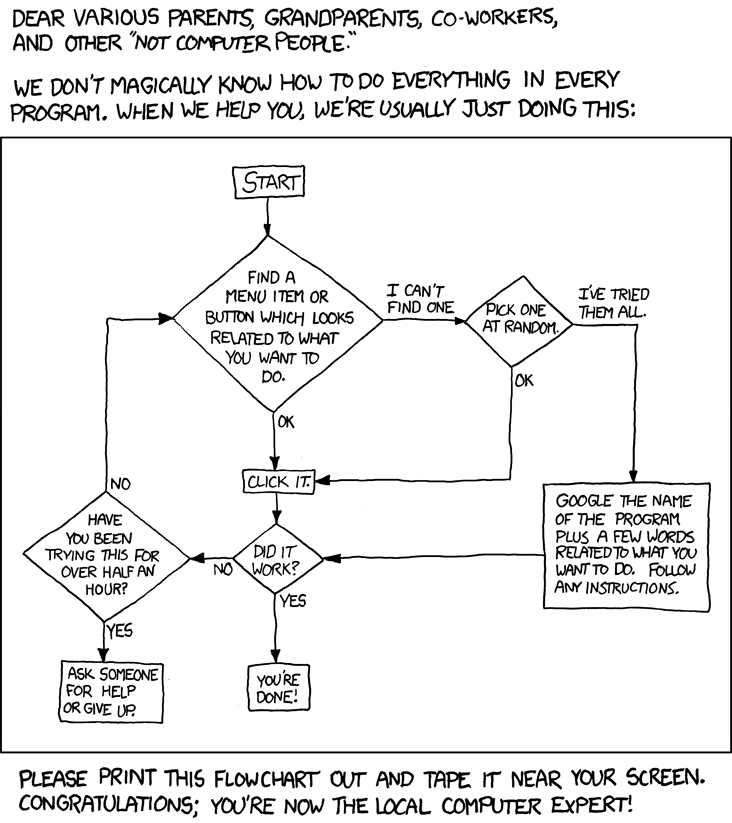
 This XKCD comic may be for tech support issues, but it holds true for about everything in the digital space.

More generally, I think that if you approach the variety of digital marketing as neither an expert or an agnostic, the autodidact process fueled by something like Google.com makes sense. Coming from a programming background before going into marketing properly, I've grown up with the idea of spending 5 minutes of searching before I would go anywhere else for the solution to a coding problem (generally because the messiness of my code means asking anyone else would take far longer). With this approach, most everything I could encounter has already been sorted and fixed by someone on a programming message board and as such, I don't have to go beyond myself and the internet to find the solution.

Now I understand that very few people within agencies are expected to know how to program anything more complex than the wonders of Microsoft Excel and a bit of VBA. However, taking this approach, breaking it down to a few core concepts and using it to understand digital marketing may make sense. If I've learned anything from programming its that:

a.) There is usually a solution to every problem you have with a computer if you just search enough

b.) There isn't much harm in trying something out either to fix an error or learn something. Short of deleting odd files or messing around with hardware, most of your actions can be undone quickly.

c.) If  'b' seems like it won't hold true, back everything up and try anyway.

d.) While something may seem rather complex, enough people had to understand it to create it and then more people had to use it until it became popular enough that you've seen it, therefore it can't realistically be that hard.

With this type of orientation towards digital concepts and a few minutes on Google, there probably isn't much that can't be figured out. Given the way information is available to us today, there really isn't a reason for anyone to say that they 'don't get technical things' or 'don't do a lot of digital marketing'. For problems from understanding how APIs work to what you can do with a Facebook page, how data comes from an adserver or how search gets ranked, you don't have to be an expert, but the basics can be found in about a few searches.

Now, finally, I will admit that rather specific or time sensitive issues might lend themselves to going to whomever has been designated as 'getting' that aspect of digital, but a genuine and fearless interest in digital marketing still shows through in conversations with others. If issues are approached as opportunities to learn, such as when you seek out solutions individually, then this genuinely comes across to others as well (instead of leaving them to feel as if the issue was dropped in their laps).

I would then humbly suggest that a truly 'digitally oriented' agency, is one that takes advantage of the wealth of information available to each individual, genuinely tackles problems alone or together (instead of avoiding issues) and knows that if all else fails, enough searches (or emails to vendors/reps/etc.) will yield useful learning and hopefully the end of a recurring problem.

Sunday, 19 December 2010

Want to Know Where Facebook is Going in the UK? Look at AOL in the US 1990's...

Before you read the title of this and make any early decisions, realize that the similarities between Facebook, now, and AOL, in the 90's, aren't necessarily bad. Given Facebook's current prominence, with 550 million+ users and a penchant for rolling out new product offerings rather regularly, similarities exist between both user bases relative to competitors and rate of development. While AOL's time may have come and gone as the central portal for the internet, the move from then to the internet we know today, may indicate where Facebook is aiming to take us.

If you didn't get one of these in the 1990's, you weren't checking the mail enough....

A comparison involving AOL in its hey day may conjure up certain memories (ever-present cd mailers, paying to play such cutting edge games as SNIPER), but its worth going back and highlighting exactly how prominent the ISP/portal was in the market. AOL's role wasn't just as a site or a network, but, given the lack of any real broadband until the late 90's, also as the actual connection to the internet.

Once connected, AOL offered a consolidated internet experience, providing user communication (chat, IM, email), media sharing/identities (message boards, photos, profiles) & entertainment (shopping & games). AOL's walled garden was the primary destination for users to do everything they needed, with the rest of the internet being offered primarily through the AOL branded web browser. The network structure allowed the brand to be in control of almost all of the user experience, sitting as a layer between the user and the rest of the internet, though it also required that a large amount of development be done in house.

Source: Pew Research Center
 As broadband increases, dial up internet peaks in 2001, before declining to negligible numbers today.

AOL's heavy development requirements became increasingly important as external internet access/broadband penetration increased competition from other options. AOL's connectivity offering granted the network a position as a user's first destination within the internet. However, as dial up penetration began to decline and broadband share moved to replace it, AOL found itself reinventing as a content portal instead of just an ISP, throwing down any part of the 'walled garden' it once used. Once competition raged, the variety of growing internet content left AOL knocked well below its original prominence and users going to multiple sites based on their content needs.

I realize this chart is a rather general estimation of 5-8 years of very complex internet development, but running out of logo space is running out of logo space.

The internet post central ISPs such as AOL is the fragmented, but robust offering of recent memory (or possibly still currently). As generalist sites/portals such as AOL were beat by specialist offerings (why not go game at a site like Yahoo! games or Newgrounds), the primary location of internet users became a sequence of daily destinations. This ordering of daily sites led to micro-struggles for prominence within categories, instead of a macro-competition. While before, the competition was AOL vs. competitors or AOL vs. the disparate internet, struggles now existed between singular sites and networks. For example, within Microblogging, sites such as Pownce gave way to Twitter and Tumblr, with each competing to be the user's main destination within the sector, not overall.


Throughout this phase of development, social networking displayed some of the most fierce competition, both within the sector and with their media sharing/microblogging/etc. neighbors. The competition between Myspace and Facebook occurred simultaneously with a battle between social networks and media hosting sites, as both aimed to be the user's destination to share media. As the dust settles, we find ourselves in the current network ecosystem. Facebook has emerged as the mass market social network de jour, with 550+ million users, while networks such as Linkedin and Myspace (which recently added Facebook connect) focus on building interest networks and widening the overall ecosystem. The struggle between neighboring sectors and social media has been abated by integration, allowing for an overall media sharing network which allows content to move between each, aiding media sites in traffic and Facebook et. al. in capacity.

It is this overall ecosystem that has positioned Facebook in a similar space as our starting point with AOL. The network has grown to feature a robust internal and external network of content, strengthening its position as not only the most prominent site in a user's daily online destinations, but aiming to move into a different category, a layer slightly above the internet. Looking at current features on Facebook, it seems to increasingly mirror that of the ISP AOL, as it internally offers:

-Communications (groups, IM, status updates, notes & most recently Facebook Message Center)
-Shopping/Marketing (Marketplace, Pages)
-Entertainment (Apps, Games) 
-Content Sharing (Photos, Video, Profiles)
In this sense, Facebook has aimed to consolidate utility for the visitor, keeping a product offering more diverse and useful than most competitors can provide.

Unlike AOL , no purely walled garden exists for Facebook as any shortcomings are strengthened through integration (i.e. Shopping on Amazon.com or brand websites using features  such as Facebook Connect, Blogs or Microblogs can be syndicated easily to pages or the news feed), extending the reach of the network without costly development. Facebook's application development structure and API have also brought a network of developers in to enrich internal content. Gaming companies, lured by the possible player base size, have created successes such as Farmville, drawing upwards of 10 million daily users to the network to play, all the while stemming off possible external competition.

Facebook's external integration brings website content into the site rather seamlessly. This content aggregation is increasingly helped by leveraging Facebook user accounts as a tool to access data on other websites, through which Facebook aims to make the web more socially integrated. Facebook's content ethos has been the antithesis of what occurred with AOL, as the more content that can be easily shared through the network (from general sites, other social networks and competitors), the greater the value of the overall experience. In this way, Facebook avoids 'micro-competition' by being an audience multiplier, not a competitor to media platforms, websites & social networks.

The difference between AOL & Facebook's integration strategies means the way forward is different for the internet's most prominent social network. However, just as AOL faced its largest challenge in broadband and the wider internet, Facebook must reconcile its position relative to upcoming trends in search. Technological shifts in the market towards more efficient search threaten to be the largest challenge to Facebook's 'integrated garden' strategy. The company must move forward to meet both market trends and competitors such as Google, in serving up information based on the organization's strengths. The patent of social graph search Facebook obtained earlier this year is a start, but users expect a functionality in line with the network's current position on the internet. Just as AOL failed to adapt widely and quickly enough to emerging changes, Facebook must keep up the pace of innovation or risk being knocked from ubiquity in the same manner.

Monday, 15 November 2010

Can Social Media Drive Positive Behaviour Change?

Social media marketing commonly uses the medium to leverage the power of our friend networks to drive purchase, get users to engage with a brand/campaign or spread recommendations. While examples of the power to drive behaviour through community engagement are readily available for brands, NGOs, political parties & charities, does the power of social media extend to positive health behaviour for users?

Our decisions about behaviour don't just come from internal factors, but are shaped by a variety of external sources, such as peer reference groups, family and the local community/culture.

In real life networks, the choice to exercise more, give up smoking, eat healthier or save more money can be influenced by those around us. The readiness to share these personal positive initiatives may be tempered by the closeness of the relationships we have with others, but generally, these can be shared experiences across our family, friend, professional or acquaintance networks. Given that the power of social networking is moving these relationships online, regardless of geographic barriers, shouldn't our positive decisions become even more incentivized?

The amount of information online supporting positive behavioural efforts is vast, with sites such as Webmd, blogs on nutrition, Facebook pages for NGOs such as the American Lung association and twitter pages for those ready to provide fitness advice. Going beyond just providing information, and reinforcing activity, seems to limit the amount of sources slightly.

 Foursquare's Healthy Eating Badge encourages healthy dining options...

Location based social networks (LBSN) such as Foursquare provide good examples in the form of their current campaigns with Runkeeper (providing badges to those who run certain amounts) and CNN on healthy eating (providing badges to those who check in at various Farmer's Markets & other locations). Promotions such as these take the search for information and incentivize activity, but what about aiding decisions and committing to them?


This rather quick analysis of phrases on twitter, shows how quickly 750 messages with these certain positive phrases are generated. Confounding tweets selling products aside, we see that most positive phrases are present in various amounts on Twitter.

The way a user shares such decisions, be it to start running or give up smoking, may vary across networks , though organic conversation seems to be the most basic vehicle for such an announcement. Just as telling fiends in person about our decisions is a tacit license to provide encouragement and engage in our efforts, doing so online, hopes to encourage those within our social group. The reach and timeliness of communication through social media is useful, but do users leverage the lasting power of relationships to enhance their health decisions?

Looking at Facebook Applications for positive health choices (Fitness (both eating & running), Smoking, Finances & Sobriety), I found 44 examples of non-quiz based applications for sharing and committing to a positive behaviour

Facebook applications are a strong candidate for sharing and committing to a positive health change, as they automate sharing progress, track data well and hold the capacity to engage friends. Looking at 4 major categories (becoming fit, saving money, quitting smoking and sobriety/substance related issues), there seems to be an indication that many different applications have built small user bases on Facebook.

Overall, the most popular applications found were Cardiotrainer (78,623) & Nike+ Run Tracker (29,786) -- (full list below). Beyond the top few applications though, a heavily fragmented sample exists. On average, each application has 3,685 MAU, but 420 with top 5 applications ignored. Usage of applications seems to mirror the expected social readiness to reveal such a decision to your friends (in both real life and online), with diet & fitness issues trumping the more serious money & substance abuse issues.

Looking at the anecdotal data from both Facebook & Twitter, it seems that both online and offline channels are regulated by similar social norms when it comes to behavioural choices. This isn't too surprising, as the way which we consider online network behaviour has moved closer to the real world in recent years. While social networking may increase the reach of our friend networks, the implications for behavioural choices and announcements frequently reverberate into the real world, meaning that influence on our choices involves both.

Does this mean that social networks don't have a greater capacity to drive positive health choices? Probably not. The issue seems to involve bringing users outside of a current network in around the choice, less than using existing friends to reinforce it. Communities of runners (either in forums, on apps, or just conversing) reinforce running behaviour, more so than non-running friends probably would. The same could possibly be said for dieters or those quitting smoking online, the shared experience between individuals in those sub groups may grant a greater authority on that specific topic.

WeQuit's Facebook app may have motivated some users during its launch on 'No Smoking Day', but its current user base (98 MAU) shows the challenge in using network involvement to drive lasting interaction around positive behaviour in social media.


So what does this mean for companies or app developers hoping to build a community to drive positive behaviour? It points to developing strengths from networking users around a shared interest, using search, collaboration and matchmaking features over the ability to post to existing networks. The power of the news feed or wall post to drive users in may work for social gaming, but it doesn't seem to be there yet in social positive health.


Appendix:

Full list of Positive Health FB applications analyzed:


Application Name MAU Category
Cardiotrainer 78,623 Fitness
Nike+ Running Monitor 29,786 Fitness
Map My Run 21,756 Fitness
My Diet 11,636 Fitness
Quit-o-meteR 3967 Smoking
Fit-ify! 3,297 Fitness
Shapelink.com Fitness Log 3,034 Fitness
CalorieStory Food Diary 2,286 Fitness
Healthseeker 1,468 Fitness
Livestrong.com Daily Dares 1,011 Fitness
Change Reaction 785 Fitness
No Smoking! 672 Smoking
Weight Watchers Tracker 470 Fitness
Weight Challenge 465 Fitness
MyMoney 383 Finances
Healthy Lungs 361 Smoking
Calorie Counter 269 Fitness
NHS Healthy Living 239 Fitness
How much money did I save since I've quit smoking? 162 Smoking
Quit Smoking Counter 158 Smoking
Stop Smoking 148 Smoking
Quitclock 144 Smoking
Quit'n'Tell 128 Smoking
QuitTracker 128 Smoking
WeQuit 98 Smoking
Feed the pig.com 81 Finances
Spark Your Life Activity Tracker 69 Fitness
Quit Smoking 69 Smoking
iChallenge Fitness 60 Fitness
Nutrition Data 59 Fitness
Virtual Smoker 58 Smoking
Sobriety Chips! 46 Sobriety
Payoff.com 41 Finances
With a little help from my friends 30 Smoking
Split Bills 24 Finances
Healthy Steps 21 Fitness
Blast n Quit 18 Smoking
Sober Gifts 18 Sobriety
How addicted are you to cigarettes 17 Smoking
Cybercise 15 Fitness
Quitters 15 Smoking
Gimmepleez 11 Finances
Smart Saver 10 Finances
Yousustain 10 Finances

Monday, 25 October 2010

The Top London Ad Agencies by Foursquare Check-in (21.10.2010) [Infographic]


London Foursquare Ad Agency Rankings (21.10.2010)

Well the only thing scarier than the psudo Halloween motif we've gone with for the pre-Halloween version of the infographic might be the clustering in the bottom left of the graph. This might be forgiven though, as McCann's immense check-in growth is a problem to scale no matter how you cut it. It really seems to illustrate the power of consolidating locations and driving activity, to the level of doubling check-ins since the last time I tried a Foursquare ad infographic. 

Also interesting is the staying power of Foursquare Activity relative to the launch of Facebook Places. It seems that agencies are slower to adopt Facebook's location platform than pre-launch hype might have suggested. At the least, it seems that users who picked up Foursquare have carried on, regardless of other options.

Tuesday, 19 October 2010

How Consistency gives Insight into Efficient Use of Facebook's 'Like'?

Facebook's 'like' feature has already become a ubiquitous part of almost any social network user's consciousness. The button, which replaced 'become a fan' functionality on Facebook pages and extends externally to websites outside of Facebook, has become one of the de facto ways to express approval for content, as well as sharing it with friends. As the prominence of the 'like' feature extends further into the internet, as seen this week with Mountain Dew's new display advertising, its power as a signaling and sharing function will only continue to grow.


External embeds of the 'like' button have allowed content which exists outside of Facebook to be easily integrated into the network, driving external content into user streams and friends within a user's network outside from Facebook. Facebook has shown that users 'liking' articles are 5.3x more likely to visit URLs in Facebook than average and have 310 friends (2.4x more friends than the normal user). Given the social, highly engaged user that Facebook illustrates liking content, it's interesting to consider how far this affinity extends. Does the 'liking' a brand or page extend past the single action into advocacy or purchase, or does this represent merely a highly streamlined sharing feature?

Does consistency grant our license to engage?

Given a lack of broad reaching hard data, a theoretical answer may come from how powerfully 'cognitive consistency' interacts with the 'liking' experience. Simply put, 'cognitive consistency' describes the harmony between what we think and what we do, the drive for which can affect our behaviour.The drive itself hopes to avoid 'cognitive dissonance' or the imbalance between our beliefs about ourselves and attitudes and our actions. An experiment by Freedman & Fraser (1960) efficiently illustrates the power of the concept:
"A researcher, posing as a volunteer worker, had gone door to door in a residential California neighborhood making a preposterous request of homeowners. The homeowners were asked to allow a public-service billboard to be installed on their front lawns. To get an idea of how the sign would look, they were shown a photograph depicting an attractive house, the view of which was almost completely obscured by a very large, poorly lettered sign reading DRIVE CAREFULLY. Although the request was normally and understandably refused by the great majority (83 percent) of the other residents in the area, this particular group of people reacted quite favorably. A full 76 percent of them offered the use of their front yards.

The prime reason for their startling compliance has to do with something that had happened to them about two weeks earlier: They had made a small commitment to driver safety. A different volunteer worker had come to their doors and asked them to accept and display a little three-inch-square sign that read BE A SAFE DRIVER. It was such a trifling request that nearly all of them had agreed to it. But the effects of that request were enormous. Because they had innocently complied with a trivial safe-driving request a couple of weeks before, these homeowners became remarkably willing to comply with another request that was massive in size."
(Quote from R. Cialdini's 'Influence the Power of Persuation')
 As shown in Freedman & Fraser's experiment, as well as Cialdini's summary, the power of a small thing, the initial request, allowed license for an acceptance of a larger request. The respondents had already agreed to one offer and therefore were motivated to stay consistent through another. Freedman & Fraser also found that the two offers didn't have to be highly related or from the same person to be effective, leading to the conclusion that the action of agreeing may fundamentally change an individual's attitude.


Relating this back to the Facebook 'like' button, we can see where assumptions can be made. Just as a small sign led to acceptance of a larger request, can 'liking' (the smaller action) lead to a larger action (such as engagement, consideration or even purchase)? The study seems to possibly indicate so, but limitations are present. The power of the 'like' button to fundamentally change attitudes hinges on the prominence of the action. The amount of prominence an individual gives the action of 'liking' may impact how effective it was to change an attitude.

The attention paid to a 'like' button varies based on how the it is presented (i.e. externally vs. on a FB page, clearly vs. obscured, supported by media vs. alone). Facebook's data shows that optimizing the position of the like button on a media owner's site increased CTR by 3.5x. Interestingly, data also showed that enabling the like button to display faces of friends who have also liked the content increased CTR by 2-3x over buttons without.

The impact of our friends...

Heider's Balance Theory Model
The impact of visible friends to motivate 'likes' relates back to another interesting theory within 'cognitive consistency', Heider's 'balance theory' (summarized well in this paper by Awa & Nwuche, 2010). Simply put, Heider created a model involving a focal point (the individual - 'P'), another individual or issue ('O') and a final individual, object or issue ('X'). As shown above, relative to the two other points, the focal point may change his views about one object ('X'), based on his view of the other object ('O') and the relationship between the two ('O-X'). By doing so, he achieves a balance in his beliefs (i.e. 'P' feels positively about 'O' and since 'O' likes 'X', 'P' may be influenced to as well).


Modifying this model to external content with a 'like button', we can see how the website ('X'), the user ('P') and the user's collective network ('O') may influence behaviour.While Heider's model is limited to three individual points, if we consider the mass of your Facebook network to be a homogenous individual (which, with apologies to Heider isn't normally the case), then we can see how the social influence of our collective Facebook friends (which we at least casually associate with and therefore probably like on average) helps to encourage an increased motivation towards an attitude shift and therefore a 'like' of content.

Implications

So, given this mass of theory and data, how can the power of consistency be leveraged to increase both 'likes' and possible after like behaviour?

Primarily, we should consider the journey of a 'liking' user very closely in planning content. By making the action of 'liking' as obvious as possible, either through supporting advertising, pre & post 'like' content or even integrating the 'like' into other advertising, we can hopefully increase the prominence in the user's mind that he/she has liked branded content.


 A prominent like should hopefully modify a bit of the user's attitude towards the brand, meaning that further communications and a clear pathway to end objectives could increase brand engagement. For example, 'liking' content on a brand's website should transition the user into a situation where, later on, they can like other external content, branded FB content or a branded FB presence. Leveraging these increased interactions, greater requests for engagement or action can be introduced.

The power of consistency seems to work best against those already warm to the content, but by utilizing the power of friends, as shown in the slightly damaged Heider model, we can utilize the need for consumer's to balance their friend network's affinity towards branded content with their own.

Given these considerations, its worth noting that none of this is a substitute for good messaging, engaging content and a clear communications strategy. But by leveraging consumer consistency, we may be able to enhance the effectiveness of a clearly planned strategy and gain further effectiveness from a ubiquitous Facebook feature.

Tuesday, 21 September 2010

Scarcity and Online Buying: Digital Behavioural Economics

The current advertising & media industry push towards a greater understanding of Behavioural Economics isn't a new thing. From Walter Dill Scott's succinctly named "The Psychology of Advertising: A Simple Exposition on the Principles of Psychology In Their Relation to Successful Advertising" in 1908 and John Watson's transition from academic to VP of JWT in the 1920's through to the en vogue works of Gladwell, Thaler & Miller today, psychology has been applied in a myriad of formats and combinations (who stole my neuromarketing & replaced it with behavioural economics!?)

That being said, looking within marketing and advertising, we can find manifestations of psychological principles in intentional and unintentional situations. While case studies are present in both online and offline mediums, examples within the digital space lend themselves to special analysis, due to the unique nature of consumer interaction online. Throughout this series of posts, I plan on taking a principle and highlighting a clear example of how a marketer has made it work well.

Scarcity and Online Buying

The power of scarcity (and/or perceived scarcity) has been heavily written about in various academic and non-academic circles through the marketing and economics fields. Given that the more academic implications of scarcity have been covered thoroughly, I'm going to focus more on the way it applies to online e-commerce.

So what is scarcity? Economics defines it loosely as "The condition in which our wants are greater than the resources available to satisfy those wants" (Arthur, 2008). However, given that arguably every purchasable good available is in someway scarce, the power of scarcity has a greater psychological power than the economic definition gives it. One psychological implication of scarcity is that it "binds rationality" (Altman, 2006), meaning that it takes an otherwise rational decision and effects the decision or purchase process. To understand the full implications of this, we need to understand how it fits into the purchase model.

The Consumer Purchase Process provides a good model to think about where different concepts effect the consumer and how we go about buying

As with many applied concepts, scarcity speaks directly to the base instincts of the consumer. The act of purchase at its most basic involves the minimization of risk and the amplification of perceived value. Everyone wants to feel like they made the best decision to get the best deal. As value is a rather unclear concept to individuals, we draw upon previous experiences (formed during previous post purchase experiences) as well as our current evaluation of alternatives presented to us. Scarcity speaks more to the way we evaluate alternatives, as it imparts a greater perceived value to alternatives deemed scarce. As the consumer search for information doesn't always produce a 'perfect' level of information about alternatives available (due to limitations or marketing communications), scarcity can be real (as in there are actually very few goods available) or perceived (as in the market is being manipulated and/or a sense of urgency is given through messaging).


Scarcity Working Well Online - Woot!

 Woot's main page features a clear message about the product on offer for the day and provides a clear path to purchase

Classic examples of creating scarcity exist in concepts such as the '1 week'/'Limited Time' sale, but also in the relatively new trend of 'Deal a Day' sites. Sites such as Woot! or larger retailers such as Amazon.com and Buy.com offer a product a day, ceasing sale of the product 24 hours after launch or when stock has sold out. By offering a desired product at a lower price, the draw to the site is already an established value. Given the threat of a sell-out, perceived scarcity becomes a heavy motivator in a quick purchase.Woot's selection of products already being considered by their target market (i.e. MP3 players, computers, etc.) means that scarcity can help along a purchase already being mulled over by the consumer.

As seen with Woot.com, scarcity as a motivator works best when a clear message exists about the urgency surrounding the product and the path to purchase is clear. With Woot! a few clicks and a login allow you to quickly and easily purchase the daily product on offer. Woot also leverages the interest created by its scarcity model into user involvement, with users supplying comments and support for the product.


Importantly, Woot! also provides metrics about how sales are going, allowing users to feel as if they have a handle on understanding how scarce the product is. In reality, the information provides no real indicator on how long supplies will last, but easy to understand metrics help to fulfill the consumer's 'search for information'.

 Woot's flashing lights on site (shown here as a real product) indicate low stock or a special event called a 'Woot Off'.

After building up a constant daily level of scarcity around its products, Woot! sporadically increases urgency through a series of cues and events. Flashing lights feature around the product as its stock is low, driving home scarcity and increasing urgency to purchase further. The Woot! flashing lights also feature on their random 'Woot Off' events, in which previously unsold stock is resold consecutively, with multiple items being featured, one after another until all are sold. Such events don't effect the scarcity of the item's original day on the site, as a sell out would prevent it from being featured in the next 'Woot-off.'

By combining a desired item, with an interested target market & a sense of urgency, Woot! creates an opportunity for purchase that might not have occurred. Looking back on the consumer purchase process, the website stimulates 'problem recognition', helps in the 'information search', negates an 'evaluation of alternatives' through perceived scarcity and drives a clear path to purchase.


Scarcity Backfires -SecretSales.com & the iPad


While Woot! manages to leverage scarcity in a way that provides a relationship with the consumer, other sites illustrate what can occur when the power of the concept is utilized incorrectly. Secretsales.com's iPad promotion, illustrates what can occur when scarcity isn't handled in a clear way for the consumer. 

Secretsales, a members only sales site, created a wave of interest on Twitter and Facebook by offering a 3 day sale of iPads at 50% their normal price. By spreading the sale's stock over three days, Secretsales hoped to graft an increased perception of scarcity on top of an already rare offering, a cheaper iPad. In doing so, they encountered site crashes on the run up to the sale, leaving many unable to even attempt to buy. Those that could get through quickly exhausted the relatively small stock, leaving a stock out message for consumers who later connected. Due to an outpouring of network abuse, Secretsales then decided to release all remaining stock, quickly clearing out and ending the promotion early. What followed was continued online abuse, with many claiming the entire sale was a scam. 


While scarcity quickly drove sales in the Secretsales promotion, the campaign itself could be considered a failure. If they planned on utilizing scarcity to drive sales this would be considered a success, but given the already rare nature of the product, such a promotion left many consumers wary of the brand and reticent to engage with them again. While Woot! and others utilize metrics and visual cues to empower consumers to understand and act on a perceived scarcity, the unclear situation put forth by Secretsales left them powerless and angry. Given the sites' objectives, raising awareness, driving registrations and encouraging repeat visits, a different promotional mechanism would have proven more effective.


Scarcity is a powerful concept to drive sales within online shopping, but it needs to be inline with marketing objectives. Post purchase behaviour can shape future interactions with online shopping portals, so scarcity must be tempered with providing an empowered experience for the consumer. By providing a clear path for purchase, informing the consumer about both the product and the buying situation and considering consumer perception once 'rationality' returns, scarcity can be applied efficiently, but not at the cost of the consumer relationship.